By TR Robertson
Admitting there are not many of them left, Colonel George Newton, U.S. Marine (Ret.), reminisced in a recent interview about his 30 years of service in three wars and numerous tours around the world. Colonel Newton served in World War II, the Korean War and the Vietnam War. He is currently a resident of Silvergate Residential Home in Fallbrook, and took some time to discuss what it was like to serve in the Marines during his very interesting time in the Corps. The residents of Silvergate refer to the 100-year-old Newton as “The Colonel” or “The Major”. Newton will celebrate his 101st birthday on April 27. Bear with the length of the article, but be amazed at the life George Newton has lived and his journey as a member of the United States Marine Corps.
The Colonel’s road toward joining the Marines began on December 7, 1941, as the 16-year-old Newton was listening on the radio, in his Wichita, Kansas home, to a Chicago Bears football game, when the game was interrupted by a special broadcast announcing that Pearl Harbor, Hawaii, had been bombed. He said not much more was said, and the station went back to the football game. Newton said he did not even know where Pearl Harbor was. He was in the second year of high school, and the next day, the event was the topic of discussion with classmates. He found out that you could enlist in the military if a parent signed for you, but he knew his mother would not allow it. He would stay in school for the next two years. His hometown, Wichita, was once known as the “Air Capital of the World” due to the number of plants that built and repaired planes and produced various components. His father and uncle worked for Railway Express Agency, a national package delivery service that transported aircraft components by rail and air. The company operated from 1918 to 1975. The Colonel said that once rationing began the major thing the company transported was rubber tires as rubber was rationed due to the war and people were encouraged to turn in rubber products, like spare tires, which were shipped to plants to produce tires for the military vehicles and various armaments. George’s father encouraged him to go to work for the company by bidding on a job at the plant. He won a bid to work there and began by driving a truck and tying together tires for shipment by rail to other plants.
The boot camp had been shortened from 13 weeks to 8 weeks due to a need for servicemen to report for active duty in the European and Pacific WW II campaigns. They had 3 weeks of the 8 with solid training on the M1 rifle. He saw no civilians for the time he was in boot camp. George mentioned the Staff Drill Sergeant they had was good, but he was replaced by a nasty Drill Instructor from Texas. There were between 100-120 Marines in his platoon and at the end 6 were promoted to Private 1st Class. He was one of them. From here he was assigned to go to Aviation Management School, a 20-week school, in Norman, Oklahoma. Upon graduation from school, he was ordered to Miramar. Things were happening quickly as his next assignment was to Marine Corps Air Station Cherry Point in Havelock, North Carolina, for a maintenance program. He said fifty people in his group, including him, were ordered back to Miramar Air Station San Diego, then to a converted cargo ship for transport to the Pacific. In thirty days, he was in a combat zone. George said they had converted the cargo hold of the ship into quarters for the Marines, the galley was on the top deck, and the latrine was over the side of the ship. From the ship it was off to Marine Corps Aircraft Group 12 on Emirau Island, a small island in the Pacific. Here he was assigned to an engineering department where his group repaired and rebuilt aircraft. He remembers working on repairing one plane that had landed safely with over 60 large bullet holes in it from an air battle. Filling in the holes and making the planes ready for flying again was a daily task. He would stay with Marine Aircraft Group 12 until the end of the war. George developed a strong sense of pride and a strong work ethic as they knew what they were doing was to make the planes as safe as they could before any were flown again.
By September 1945, his service time was complete, and the entire Group 12 was transferred to Mindanao. While here he joined in with other athletic soldiers on a baseball team. He remembered flying on a B25 to a neighboring island to play against a Navy team managed by Yankee shortstop Phil Rizzuto. By August 6, 1946, George was discharged on Treasure Island, near San Francisco. His plan was to return home and use the GI Bill to go to college to major in accounting at the University of Wichita.
It was here, in 1947, that George married 19-year-old Eva Rose, a marriage that would last for 75 ½ years.
He first attended Friends University in Wichita, where he played baseball for 2 years. Finishing this quickly, he enrolled at the University of Wichita and signed up as an inactive reservist to make sure if he was called to active service or be drafted again, he would go in as a sergeant. As fate would have it, tension was rising in Korea and in 1949, George received orders his senior year at the university to report to El Toro for duty. Letters from the university president and others helped him remain at the university until he completed his final classes to graduate in 1949. By December 1949, he reported to El Toro. The Korean War began in 1950 and would last until 1953. While at El Toro he began a special program to receive a Reserve Commission as an officer. The military was short of officers as many had opted out after the end of WW II. George applied, was selected and sent to the University of Oklahoma for an interview and was selected to take part in their ROTC program. When had finished, his commission had been erroneously sent to the University of Kansas in 1951. He had already been sent to a service squadron at El Toro to wait for his commission. He spent time typing up lists of names of those being assigned to Korea. While doing this, one day an officer entered where he was working, told him to stand at attention, had his Sergeant’s stripes cut off both arms and Lieutenant bars clipped to his shirt. With this short ceremony he was now a Marine officer.
Now an officer, he was sent to Marine Corps Base Quantico Virginia, for a 28-week aviation supply school. During this time, he was promoted to 2nd Lieutenant. While in the school he was selected to go to an independent Marine squadron in Santa Ana, California, which was in an old blimp base that had been converted into a supply depot. As a 2nd Lieutenant he replaced a Colonel who was the former supply officer for the observation squadron. It was here that his wife, Eva, agreed that he should extend in the Marines. In 1950, George left for Korea, assigned to Marine Observation 6 in Incheon, South Korea, 38th Parallel. George spent 17 months here helping keep the supplies coming in to keep the planes flying for their missions. He even had a chance to take over 200 flights in country with the pilots on the base. It was also here he applied for and was granted a regular commission. In 1951 he received orders for 2nd Marine Division at Marine Corps Base Camp Lejeune, Jacksonville, North Carolina. While there he went through a reselection process and was promoted to Captain in the 2nd Battalion 6th Marine Division and spent six months as a Logistics Officer. His boss was Major Robert Barrow, who would eventually be promoted to General Robert H. Barrow the 27th Commandant of the U.S. Marine Corps 1979-1983.
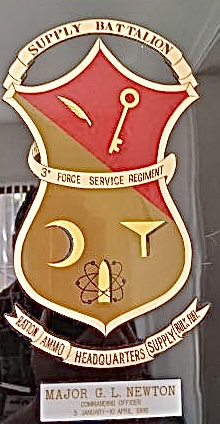
Going through the ranks and other positions Newton would go through, he was sent to Evansville, Indiana, where he would be assigned to assist in training a reserve rifle company. He would then be assigned back to Camp Pendleton, where he was promoted to Major. His next assignment was to Hawaii as the Marine Corps Station Supply Office for a brigade. He was the Supply and Fiscal Officer for Maintenance and Defense for Marine Aircraft Group 13 until the Brigade was deployed to Okinawa. He went to Vietnam three times and the third time he stayed for five months in Da Nang where he became the Operations Officer for Maintenance and Defense of the airstrip in Da Nang. Back in Okinawa he became the Commanding Officer of Supply Battalion until his time overseas was up, at which time he was ordered to Marine Corps Supply Activity in Philadelphia, where he was promoted to Lt. Colonel. Newton was then ordered to Headquarters Marine Corps where in the mid-sixties he was promoted to Colonel. Newton served at the Pentagon with the Quartermaster General, the staff officer in charge of supplies for the entire Marine Corps.
By 1972, Colonel Newton had decided that his wife had had enough Marine Corps life and constant moving and he retired, moving to Fallbrook, California where he has lived for over 50+ years formerly employed as an income tax agent, building quite the clientele at Newton and Associates. In fact, he has even helped some of his friends at Silvergate with their taxes. He is happy to say that his long-time office manager, Jennifer, visits every Monday, Wednesday and Friday for lunch with him and visits with some of the other residents of Silvergate. George has been at Silvergate for three years.
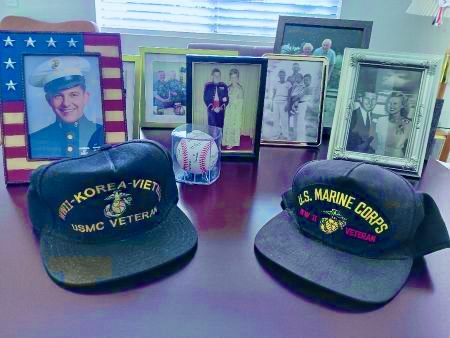
On a sadder note, but a proud note as well, his son Marine Lance Corporal Barrie Newton was killed in action in Vietnam in 1969 and his son Lieutenant Colonel (Ret.) Johnnie Newton died in 2023 from cancer caused by Agent Orange. George lost his wife of 75+ years, Eva Rose, in 2022. George had been selected as a participant in the Honor Flight San Diego trip in 2012 and he remembers an emotional moment at the Vietnam Memorial where he found his son Barrie’s name engraved on the wall and they were there for the opening of the Vietnam Memorial Fund “In Memory” plaque, near the Three Serviceman Statue, which honors veterans who died after the war due to service related injuries.
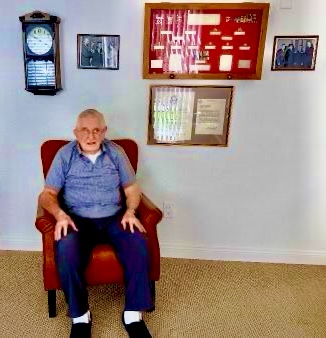
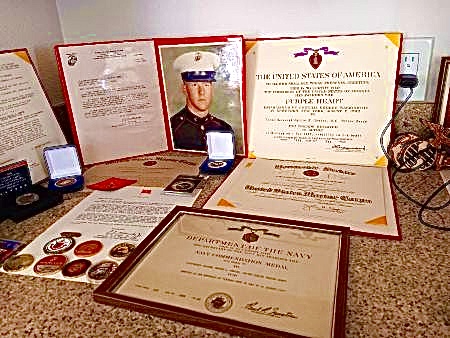
George Newton is a proud Marine and has several displays on tables and walls in his room at Silvergate, including photos, awards and commendations he has been awarded over the years. There are also pictures of his wife and sons displayed in photos on the tables.
He has said, “I was just at the right place at the right time. I have had so many people, military, civilian, others bear with me and have had confidence in letting me do my job.”. He emphasized again as I was leaving after a 2 ½ hour interview, “I was just doing my job the best I could.”
U. S. Marine Colonel George Newton, (Ret) a man to be respected, honored and remembered for the service he gave to our country over the years.