
A new state study may examine advanced nuclear technologies, but the evidence already exists: reliable, carbon-free power will be difficult to achieve without expanding nuclear energy.
The state is taking the first step in reenergizing its nuclear potential.
Gov. Gavin Newsom signed Assembly Bill 2647, authored by Lisa Calderon (D-Whittier), which requires the California Energy Commission to conduct a comprehensive analysis by Jan. 1, 2028, of whether advanced technologies could play a useful role in achieving the state’s long-term electricity, reliability, and climate objectives.
Not that the state needs another study to analyze those questions, as decades of proof and real-world implementation have already established nuclear as the greatest electricity source in history. I’ll save the CEC some time.
Nuclear is the most reliable energy source ever created, among the cleanest, the most energy-dense, and, when amortized over decades, the most affordable over a power plant’s lifespan. A power plant needs orders of magnitude less land than solar or wind.
Solar uses 72 times more land to generate the same amount of power as a nuclear facility, according to the U.S. Department of Energy. For example, the hyperscale data center proposal in Imperial County would require 13 square miles of solar panels and batteries compared to 500 to 700 acres for a nuclear power plant.
The state has had a moratorium on new nuclear construction since the 1970s, arguably the height of the anti-nuclear movement. But the world has changed radically, especially with the state’s ambitious clean energy goal of 100% zero-carbon by 2045.
Without nuclear, the state’s 2045 target becomes more fiction than reality. If zero-carbon emissions are the goal, nuclear has to play a major role, as it doesn’t produce combustion emissions and is in the same tier as solar and wind for greenhouse gas emissions.
Nuclear is one of the few technologies that combines near zero-operational emissions, has a high-capacity factor, multi-decade lifespan, extremely high energy density and around-the-clock reliability.
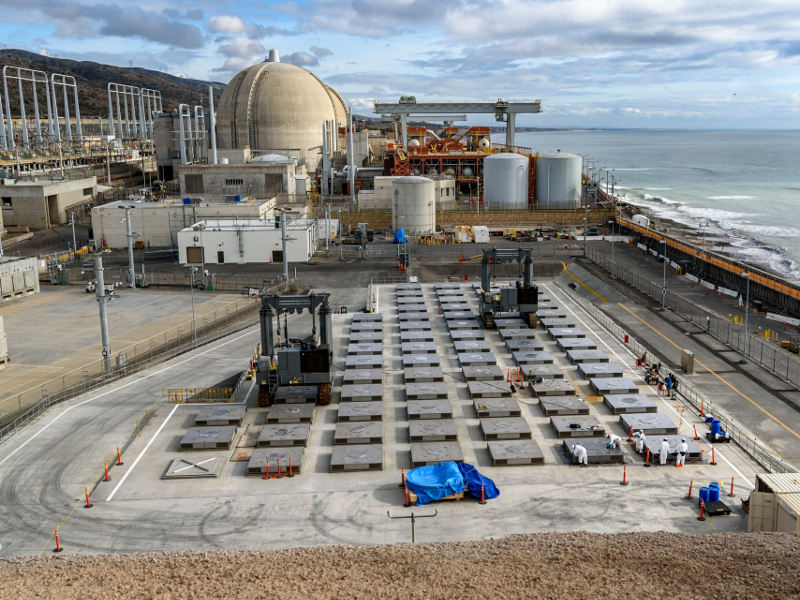
When San Onofre Nuclear Generating Station (SONGS) was shut down in 2013, one of the most colossal mistakes in the state’s history, utility companies had to find replacement power. According to a study from UC Berkeley, replacement generation increased natural gas generation costs by $350 million in the first year after SONGS shut down. Ratepayers bore much of those costs.
Heat waves place enormous stress on the grid, and with the state’s current energy mix, planned outages are the norm now (as witnessed this weekend). When SONGS was operating, planned outages during major heat events were few and far between.
One can’t have a reliable grid with unreliable and variable generation. The Iberian Peninsula blackout emphasized the importance of grid stability services that firm generation resources naturally provide.
Unlike a nuclear power plant, solar panels and battery systems require recurring replacement and repowering costs throughout their lifespan. As panels degrade and batteries lose capacity, utilities or third parties must periodically invest in new equipment, reducing some of the long-term cost advantages often claimed by renewable-only advocates.
I spoke with a firefighter earlier this year about the Otay Mesa battery fire from January 2025. Firefighters were still having issues keeping it under control as of April.
Moss Landing, one of the largest battery facilities in the world, had yet another fire on Sept. 17, causing a shelter-in-place order to be issued. It’s the fifth reported fire or safety incident at Moss Landing since 2020. While batteries definitely have a specific use, they are also an environmental liability when failures occur. A battery fire can release tons of emissions and toxic material into the air, which can spread across several miles.
The legislature must tackle this problem furiously and work to unleash the power of nuclear. They must also allow utility companies to have vertical integration (ownership of power plants) to lower rates and leverage existing infrastructure to keep costs down, along with a wholesale review of its rooftop solar, Community Choice Aggregation, and other programs and the impacts on rates.
This will no doubt become a political battle over the next several years. Public sentiment on nuclear, though, is at near-record highs. A 2025 Gallup poll found 61% of Americans support nuclear energy for electricity generation, and a 2025 survey by Bisconti Research showed 72% in favor.
The divide also comes along political lines, with 74% of Republicans, 64% of Independents, and just 46% of Democrats in support. And with a supermajority of Democrats in the state Legislature, any forward progress is going to be an uphill battle.
Arguably, the biggest issue is nuclear waste, rather than generation. There was widespread concern with a cracked cask at SONGS several years ago, but that incident is a case study in how the proper protocols work.
Waste solutions exist, and protections and protocols are in place. They’ve worked in the past and continue to work now. Congress is unlikely to ever get anything done on waste, notably wasting the facility at Yucca Mountain in Nevada, which the late U.S. Sen. Harry Reid and others fiercely prevented from being a site and used anti-nuclear rhetoric and outlandish claims to keep the repository a ghost town.
But therein lies an opportunity. Spent fuel is reusable, and reactors can be built for that specific use. France has been using this technology for decades. Reusing the waste also significantly cuts down on the half-life of the radioactive material.
Stability and more generation across the grid, though, are critical for the future. As load demands increase, power sources must scale, and nuclear is a proven winner on both fronts.
I realize it can take up to eight years to build a nuclear power plant, but those can stay online for more than 60 years, and up to 100 if maintained.
The track record is there, but is the political will?