
Honor Flight San Diego Once Again Provides Memories for Veterans
Part 5 – Vietnam Women’s Memorial, Vietnam Veterans Memorial, Korean War Memorial, and the Lincoln Memorial
By TR Robertson
The final memorials we visited on our Spring Honor Flight 2026 trip were located at the western end of the National Mall, all within a very short walking distance of one another. The first set of memorials we saw on the Honor Flight Veterans Tour are majestic, fascinating, stunning, historical and educational; but the four listed in the title above are perhaps the most moving and emotional of those that veterans see. Our bus parked along Lincoln Memorial Circle behind the Lincoln Memorial to begin this final part of the tour.
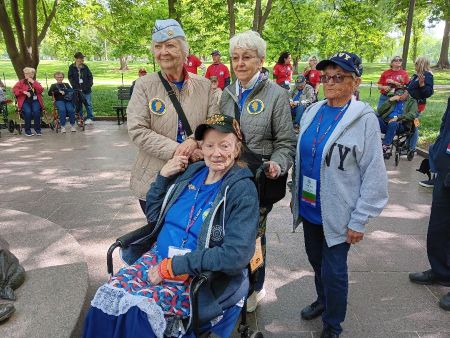
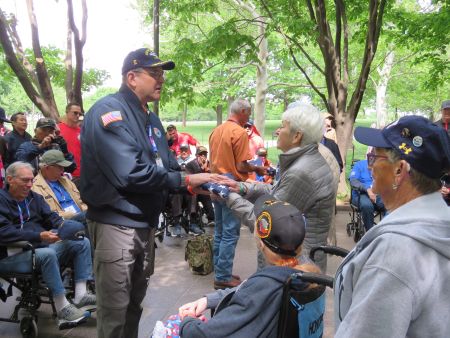
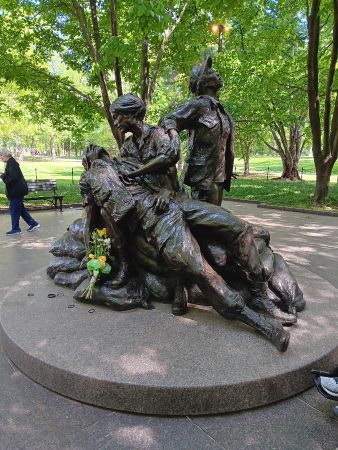
We walked around the Memorial toward the Vietnam Veterans Memorial, first walking over to the Vietnam Women’s Memorial Statue for a special presentation for the women veterans on our trip. This Memorial statue was designed by Glenna Goodacre and honors the 265,000 nurses and women who served in the Vietnam War. The statue shows three uniformed women aiding a wounded soldier symbolizing the care and assistance nurses and specialists provide all military service personnel. The statue was dedicated on Memorial Day in 1993. Many in our Honor Flight group gathered by the statue for a presentation of an American flag to each of the women veterans in attendance.
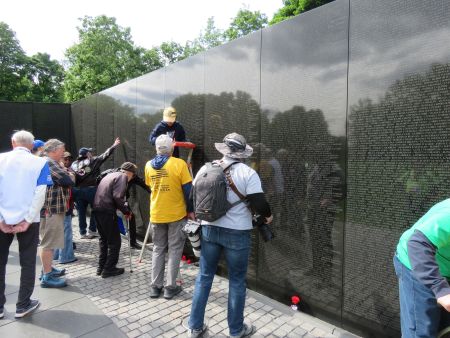
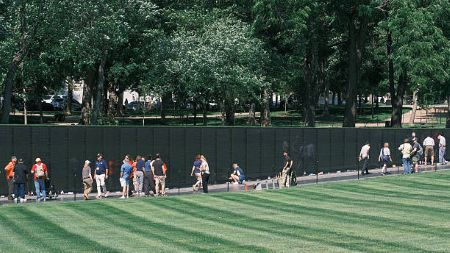
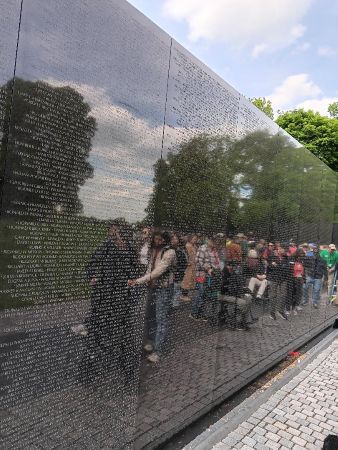
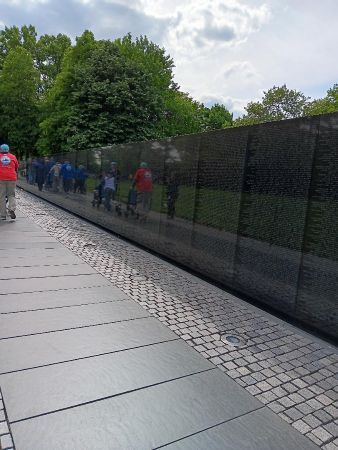
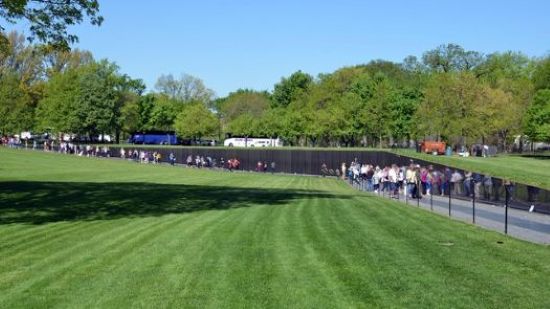
From here, we headed right to enter the Vietnam Veterans Memorial, a tribute to the 58,318 service members who died or remain missing from the Vietnam War. The Memorial is a 2-acre V-shaped black granite wall site, with 2 246 feet long walls that meet at a 125-degree angle. The end of one wall points toward the Washington Monument and the other end points toward the Lincoln Memorial. The walls are made of 72 black granite panels, polished to a high finish, which taper from 8 inches tall to 10.1 feet tall in the middle. Visitors walk the length of the wall beginning at ground level then descending below ground level then ascending back to ground level. This has been said to “symbolize a wound that is closed and healing”. Many people who visit the wall can be seen making rubbings of the names on the wall of loved one or friends who died in Vietnam. There are ladders available to reach names on the higher portions of the wall. A special rubbing paper is advised and there is a web site where you can request a rubbing be made of a name you are looking for if you fill out the information requested on the form. The granite for the wall was quarried in Bangalore, India. The wall design was the result of being selected out of 1,421 design entries. The winning design was from 21-year-old Yale University student from Athens, Ohio, Maya Ying Lin. The Wall is engraved with names listed in chronological order of date of casualty, alphabetized in the dates. The names are engraved in Optima typeface. Directories of the names and their location on the wall are located on nearby podiums at both ends of the Memorial. Those who are confirmed as dead have a diamond shape next to their name. Those whose status is unknown are denoted with a cross sign. The names begin and end at the center, meant to form a circle indicating the completion of the war. The earliest date of eligibility is November 1, 1955, when President Eisenhower sent a military advisory group to train the Army of the Republic of Vietnam. The last date is May 15, 1975, which corresponds to the final day of the seizing of the USS Merchant Vessel Mayaguez by the Khmer Rouge. Thirty-two names were erroneously placed on the Wall; the names still remain but have been removed from the database. Eight women’s names are on the Wall, all nurses. 162 of the names are Medal of Honor winners, 33,100 were 18 years old and 12 were 17 years old at time of death. A Memorial Plaque was dedicated in 2004 to honor veterans who died after the war as a result of injuries suffered in Vietnam, but who fell outside of the Department of Defense guidelines. Many of these deaths were the result of PTSD illnesses, Hodgkin’s and Parkinsons and exposure to Agent Orange and cancer. Sentimental items still continue to be left at the wall. The National Park Service periodically collects the items and puts everything into storage. Since 1982 over 400 names were added to the Memorial, not in chronological order. One interesting fact about the Wall is that if you are looking toward where the Wall exists from Constitution Avenue NW, you cannot see the Wall as it is sunken behind the ground above the wall. Also, when you are at the Wall you cannot hear the busy traffic on Constitution Avenue. The Wall was funded by $9 million from private contributions and is called “The Wall that Heals”. For many of the Vietnam vets on the trip who were seeing the Wall for the first time, this was an emotional experience but one they had looked forward to. For many it brought back memories and a time for reflection.
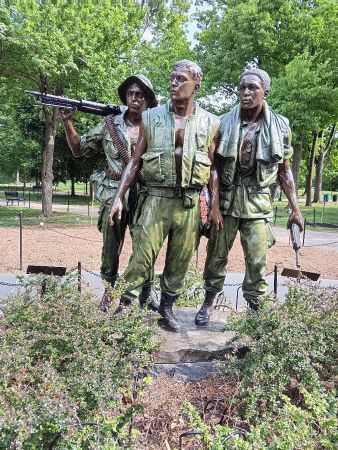
Close to the entrance of the Wall, on the side pointing to the Lincoln Memorial, is the Three Servicemen Statue. This bronze statue is 7 feet tall on a 1-foot base. It represents the diversity of those who served in the Vietnam War, primarily a European American, an African American and a Latino American. The statue was built by American sculptor Frederick Hart and dedicated on Veterans Day 1984 by President Ronald Reagan.
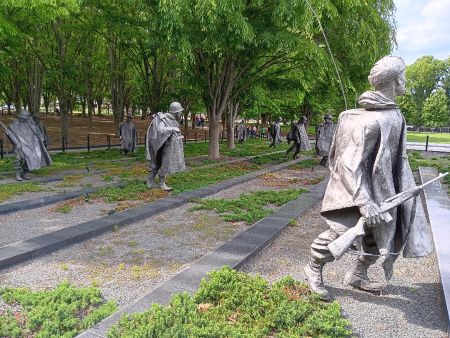
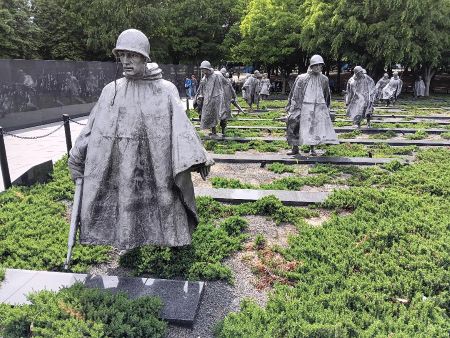
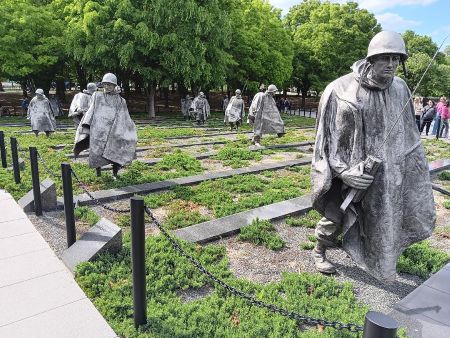
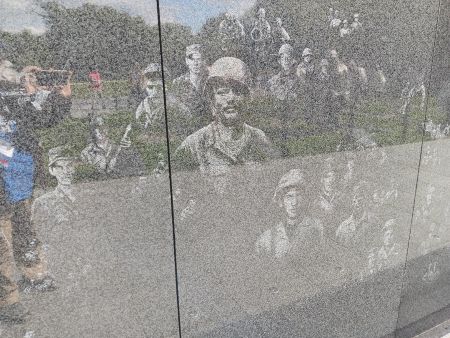
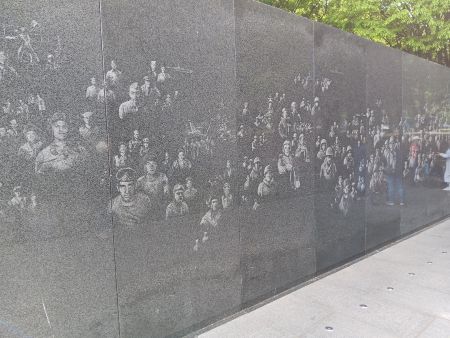
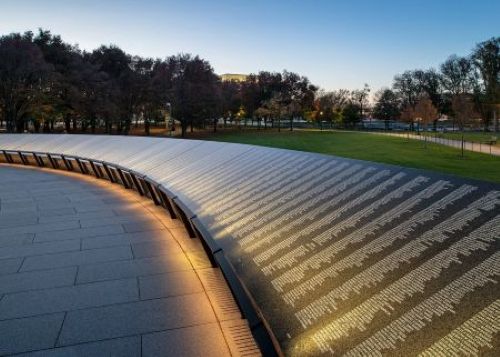
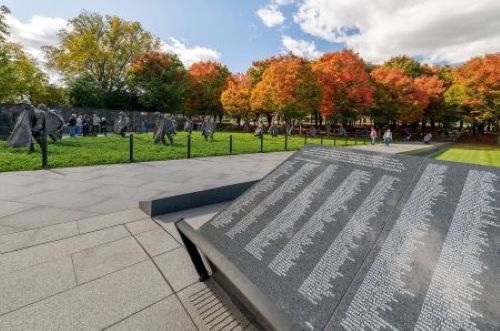
Going past the statue, we entered the area dedicated to the Korean War Memorial. The Memorial consists of two sections, 19 larger than life stainless steel statues that appear to be on patrol located next to a wall of photographic images and a Wall of Remembrance close by with names of U.S. Military personnel and South Koreans in the U.S. Units who died in the Korean War. The statues and wall of images were dedicated in 1995 by President Clinton and South Korean President Kim Young Sam. In 2022 the Memorial was expanded to include a granite memorial wall engraved with the names of those who died in the war. The 164-foot wall of images has more than 2,500 photographic images representing land, sea, air troops. The images were sandblasted on the wall. This mural wall was created by Louis Nelson. The 19 stainless steel statues are in a large triangular space, designed by Frank Gaylord. The larger-than-life patrol is called “The Column”. The statues range from 7’3” to 7”6” tall, each weighing 1000 lbs. There are 14 U.S. Army members, 3 Marine Corps, 1 Navy Corpsman, and 1 Air Force Forward Air Observer. There was some controversy with the “Wall of Remembrance” and the 36,634 American and 7,174 South Korean names. The wall initially had many mistakes, such as misspellings, names included from deaths unrelated to the Korean War and names that were omitted that should have been on the wall. Steps are underway to correct the more than 1,000 errors.
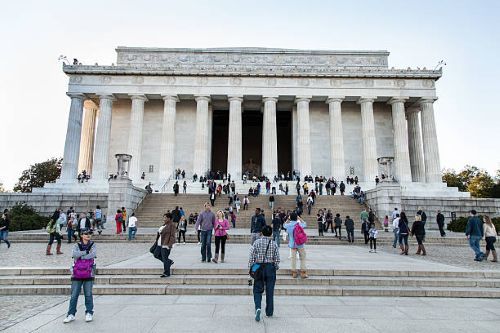
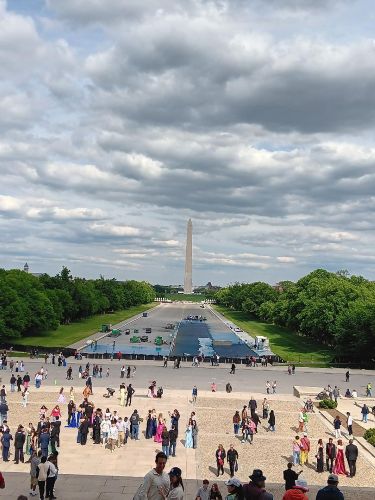
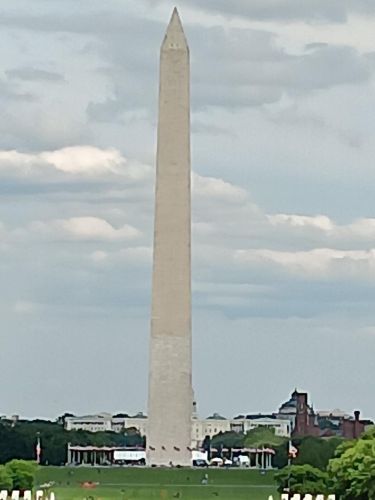
From here it was another short walk to the most visited memorial in all of Washington, D.C., the Lincoln Memorial. Walking past the western end of the National Mall it resembled a scene you might see in Balboa Park in the Plaza de Panama by the San Diego Museum of Art. Lots of folks just hanging out, music playing as people were enjoying themselves dancing, folks walking from one spot to another and the Lincoln Memorial steps filled with people just sitting looking down the National Mall toward the Washington Monument. I would have said looking at the Reflecting Pool, except it was drained and in the process of being renovated for the 250th Anniversary and having the entire pool painted “American Flag Blue”. Another fascinating activity going on was quite a few very stylishly fashioned young people in front of the Lincoln Memorial, on the steps of the Memorial and at the top of the entrance into the Memorial, most of them having pictures taken. The occasion, I was told, is numerous private schools have a tradition of going to the Lincoln Memorial on prom night for photos. You could see numerous limos pulling up dropping off more teens. Unfortunately, the classic view from the Lincoln Memorial looking down at the National Mall with the Reflecting Pool and Washington Monument in the background wasn’t quite the classic picture at that moment due to the construction underway.
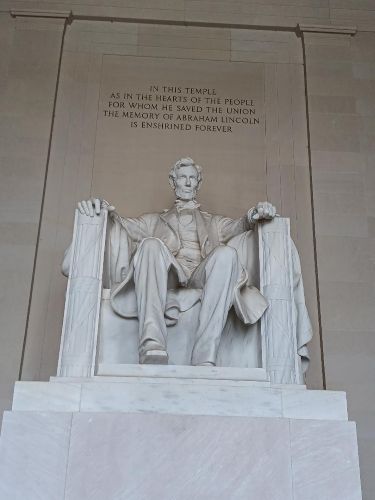
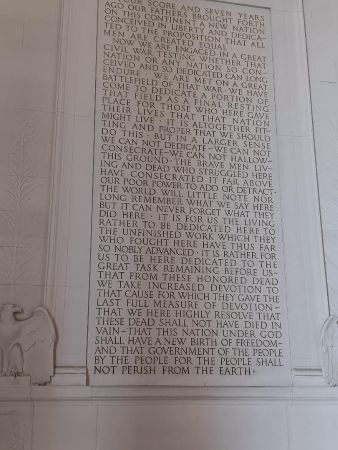
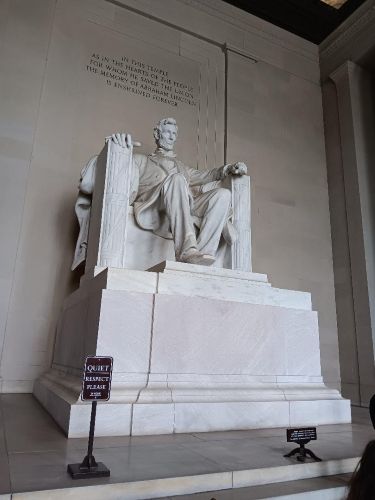
We continued on to the Lincoln Memorial and took the elevator up to the Main Chamber area where the classic statue of Lincoln sits. The Memorial is built in Neo-classical Greek Revival style designed by architect Henry Bacon. The large interior was designed by Daniel Chester French. Entering the first room of the Main Chamber, on the wall is a huge engraving of the Gettysburg Address. In the Main Chamber room sits the massive statue of the 16th President of the United States, Abraham Lincoln. The statue was carved by the six Piccirilli brothers under the supervision of sculptor French. It took 4 years to carve. On the opposite wall of the third Chamber Room is another engraving, this one is Lincoln’s Second Inaugural Address. The statue is 19 feet tall from foot to head, sits on a 10-foot-high oblong pedestal made out of Tennessee marble and this sits on a 6.5 in. platform, also made out of Tennessee marble. The statue weighs 159 tons and is made out of Georgia white marble. Above Lincoln’s head is an engraving of an epitaph of Lincoln by Royal Cortissoz, a former American art historian. The Main Chamber was a bit crowded and many of the prom kids were close to the steps leading to the plaza getting their pictures taken. Going back down on the elevator we walked in front of the Memorial. The elevator was added in the 1970’s. Eighty-seven steps lead from the plaza to the Main Chamber. There are 36 columns in the Memorial, representing the number of states in the Union at the time of Lincoln’s death. There are 48 stone festoons above the columns representing the number of states in the United States in 1922, the year the Memorial was dedicated. The Memorial has been the site of numerous massive gatherings, such as Martin Luther King, Jr.’s “I Have a Dream” speech, this ended the March on Washington for Jobs and Freedom where over 250,000 people congregated. It was even used for the “Anti-war scene” in Tom Hank’s “Forrest Gump” movie.
Our 4:30 pm departure time was nearing and the vets began making their way back to the buses to return to the BWI Hilton to prepare for our 7:30 pm “Tour of Honor” Saturday Departure Dinner. The final article of the Honor Flight 2026 Tour, Part 6, will cover the Departure Dinner and guest speaker, Airport departure and flight home and the amazing arrival celebration in San Diego at Terminal 2 baggage claim.