

By: Brian Robertson Photos by: Golnessa Shali
In eastern San Diego County, resting deep in the valley of Santa Ysabel lays one of the most beautiful, magical, surreal, and dreamlike architectural man-made wonders I have ever had the pleasure of visiting. Located on 10 acres of oak woodlands near Julian is the Ilan-Lael compound that encompasses the historic Hubbell home, living quarters, working art studios, gallery space, gardens, and the James and Anne Hubbell Center for the Arts. Ilan-Lael is Hebrew for “a tree that unites the physical and the spiritual,” which is a fitting name for this space that integrates art, nature, and community in a vibrant and energetic setting. In the late 1950’s, when Jim and Anne were just in their 20’s, they were looking for a place to start a family and finding nothing on the east coast, where they were from, they navigated west to California landing in San Diego. When driving around the county Jim came across the land in Julian and saw the potential of what it could offer him and his new wife. They purchased the land for around $500 an acre. Since then, James Hubbell has produced buildings, hand-crafted doors (like the Palace Doors of Abu Dhabi), stained-glass windows, gates, and sculptures all using wood, stone, metal, glass, and clay from the nearby areas. Everything is sustainable, made from the earth and his work takes on the feel as if it grew itself from the surrounding landscape. His designs, buildings, and structures are referred to as having an organic and life-like style, and sometimes “hobbit houses”. I felt as if it was more J.R.R. Tolkien’s Elvish meets Frank Lloyd Wright with the much-added details of Jim Henson’s Labyrinth. Especially once you see Uncle’s Bert’s Garden and all of the donated creatures and troll sculptures, you’ll understand. Everywhere you go on this property you feel the energy and life that this peaceful and magnificent landscape has to offer. With no pun intended, this includes one of my favorite buildings as well. The charmingly decorated crown shaped Adu Bathroom, which of course is the throne room, or guest bathroom, which sits in the middle of this property. The bright lemon-yellow tiles will definitely put a smile on your face the moment you walk in so don’t be afraid to ask for the bathroom while you are there visiting. I guarantee you will enjoy it.
James Hubbell lived and worked here until the age of 90, and one year ago to the day of our visit, James Hubbell passed away at the age of 92 on May 17, 2024. This past Saturday, on the one year anniversary of his passing, we had the pleasure of being on a docent-led tour by James Hubbell’s oldest son Torrey and his wife of 42 years, Sally Hubbell. The way they both spoke of their first-hand experience of working on these structures with Jim and Torrey’s stories of living here and collaborating with his father, mother, and eventually brothers breathed a whimsical life into the tour as they walked us through their past. Stories like the time Torrey remembers as a young child of his father making wax sculptures for bronze castings on the cold winter nights. Jim built tiny homes before tiny homes were a thing. He realized that you didn’t need something big to get the function out of it. He would build a structure to fit the landscape and the needs of his family. The first structure went up in 1958 and they lived there for years with no power and water. Anne had to go to the local manzanita ranch and fill empty cider jugs up with water until the two wells were eventually installed. As their family grew, so did the buildings on the property. Save money, build a structure, rinse, and repeat. The houses were inspired by the adobe structures of New Mexico and surrounding areas. Building something that would be cool in the summer, but warm in the winter. Each living structure is adorned with small fire pits to heat the rooms. Intricate inlaid mosaic tiles run from floor to ceiling as if the lines and paints of one of his watercolors were leaking out of its frame and with paintings of beautifully colored veins running into the homes. The time, effort, love, and passion that it took to design, create, and build these gives proof and testament to the true idea of what human nature really is.
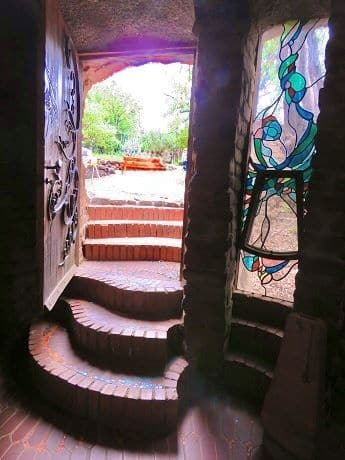
In the 1960’s, the Hubbell Home was built that included the kitchen and living room that was only 750 sq. ft., but could comfortably fit 16 plus people for Thanksgiving and Christmas dinners. Everything, including the original furniture was built by James Hubbell, but was unfortunately lost in the Cedar fire of 2003. By 1970, the Hubbell family was comprised of two adults, and four children, so the Boy’s House was built. It is a habitable sculpture that is a masterpiece of James Hubbell architecture, artistry, and flourishes. Most of the elements are handmade, including the tiles leading into the house that Torrey remembers help making as a child after school. The only way to describe this structure would be to imagine if Disney’s “Encanto” was drawn by Salvador Dalí. It is beautiful and mystical with inlaid desks, spiraling stairs leading to a loft, a mosaic bathroom with abalone shells and stained-glass ceiling, everywhere you look, there is something new to see. Then there’s the pool (with fountain) and hot tub, all hand-dug and sitting amongst a boulder outcrop atop a ridge higher than the surrounding residences, all mosaic of course. He never cut a tree down or moved a boulder if he didn’t have to in order to build his structure. He would build around it or incorporate it into the building.
Much like his family, James Hubbell’s art practice also grew, so of course by design did more buildings grow from the ground up. In the 1980’s there was the addition of his studio, workspace, and kiln for large and small projects in metal works, stained-glass, sculpture, and woodworking. Each structure would breathe more life into Ilan-Lael, that are now being used by local artists, students, and visiting artisans. Each person coming through here creates new and exciting original works, repair and refurbish existing Hubbell art pieces, and carry on the tradition of James Hubbell and his hand-made craftwork. This includes current resident artist, Dan Thoner, who had worked with Jim for over 15 years helping build his creations as well as still using the grounds today creating his own masterpieces. In 2003, the Cedar Fire swept through this entire area causing massive damage or completely destroying the original buildings, losing almost everything on the property. One fireman, Engineer Steven Rucker, who was helping to defend the area, lost his life in that fire and in honor of him there is a tribute built here. Over the course of three years with the help of friends, family, and the community, reconstruction and restoration of the facility occurred. By 2008, Ilan-Lael had transitioned to being a public art sanctuary for classes, retreats, and immersion in nature. In 2008, they were successfully nominated into the San Diego County Historic Register. Approaching the end of the grounds tour we were taken up to the Chapel. This art-infused open air meditation space was built as a tribute to Mother Nature herself. It is nothing short of picturesque as it embraces the surrounding landscape. Here also holds some of James Hubbell’s ashes as a sort of peaceful resting place for him to be a part of his own creations.
You feel the love and dedication that James Hubbell wanted to give back to Mother Nature. It wasn’t just here in Santa Ysabel either. Since the establishment of the Ilan-Lael Foundation in 1982, by James and Anne Hubbell, the not-for-profit organization has sponsored public art, lectures, and seminars in both San Diego and Tijuana. Jim led international teams of architectural students in a project called Pacific Rim Park, for building friendship-themed public parks (in 30 days no less) in San Diego, Russia, the Philippines, South Korea, Taiwan, and China. In 1995, James started collaborating with his son Drew, who leads the firm Hubbell & Hubbell Architects, whose idea is merging art and architecture in ecologically and aesthetically mindful ways. James Hubbell was a devoted husband, encouraging father, lover of nature, teacher, sculpture, watercolorist, architect, stained-glass artist, and a poet (yes, that too). He was a true Renaissance man for Mother Nature and I highly encourage everyone to go and experience the creative energy that surrounded the life and space of James Hubbell and his family home and studio.
Over 200 photos were taken during the visit, about 75 shown in the article. There is something to take a photo of at every turn with stained glass, sculpture, art work and unusual buildings everywhere.
“Architecture must take measure of all that it is to be human in a world that is whole. It must take count of our galaxy and of a smile.” – James Hubbell
Please visit https://ilanlaelfoundation.org/ for more information on tours and events.