

NORTH COUNTY — On Tuesday, voters who have not yet mailed their ballots will head to the polls to cast their votes.
In addition to local elections and two countywide measures — one to extend term limits and give the San Diego County Board of Supervisors more power, and another half-cent sales tax proposal — voters will also see 14 statewide propositions.
Two measures have generated the most attention: the so-called Billionaire’s Tax (Prop. 40) and Voter ID (Prop. 39). The controversial measures have led the way in coverage, debate and discussion, but there are other ballot measures with significant changes to the state.
Other measures include recall election reforms (Prop. 5) and a proposal requiring citizen-led tax initiatives to meet a two-thirds (66.67%) approval threshold to pass (Prop. 43). Also, two housing bonds are on the ballot, one for $11.25 billion and a $25 billion homebuyer loan program.

Voters will also decide whether to reform the California Environmental Quality Act (Prop. 45) to streamline housing, infrastructure and other qualifying projects. Known as CEQA, the original version was passed in the 1970s and has been a controversial law ever since.
Polls are open from 7 a.m. to 8 p.m. on Tuesday. Below are outlines of each proposition.
Prop. 1 (Veteran and Housing Assistance)
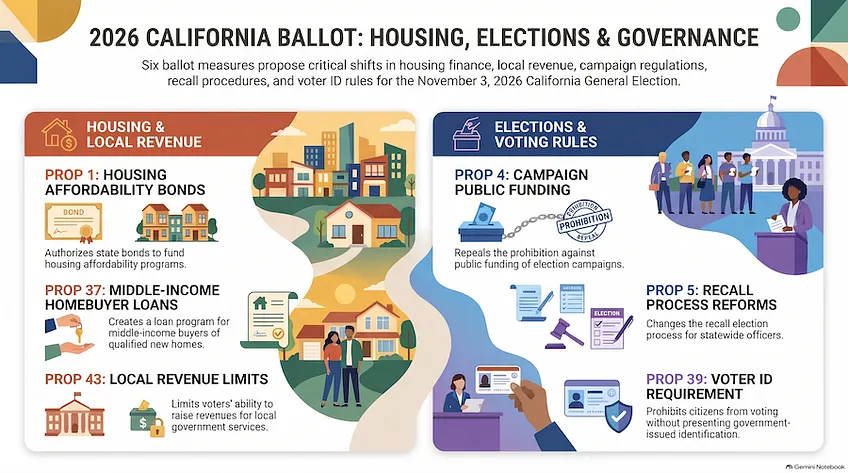
California voters would decide whether the state can borrow $11.25 billion to support housing construction, affordable housing developments, veteran home loan programs and youth housing initiatives. The measure would authorize the state to issue general obligation bonds, providing upfront funding for programs such as affordable multifamily housing projects and the CalVet Home Loan Program.
Because the funding would come through borrowing rather than direct appropriations, projects could move forward immediately while repayment would occur over future decades through state budgets. If approved, state agencies would be responsible for administering and distributing the bond funds.
The direct authorization totals $11.25 billion, with the ultimate taxpayer cost expected to exceed that amount once interest is included.
Prop. 2 (State Rainy Day Fund)
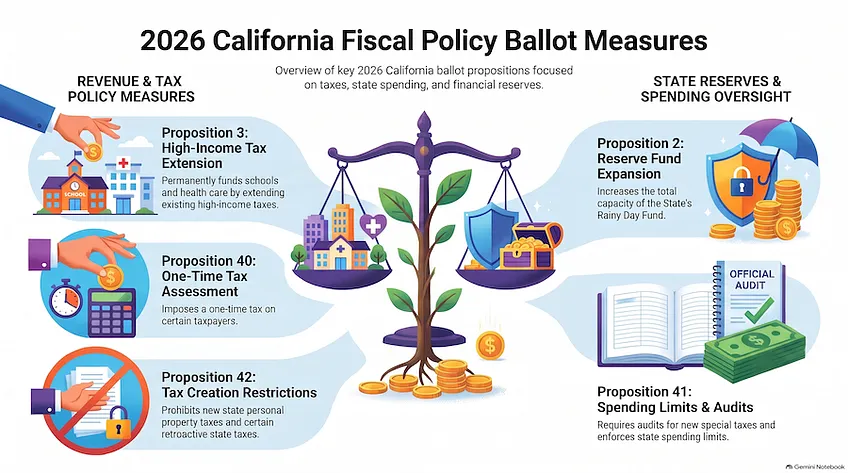
This measure would increase the constitutional cap on California’s Budget Stabilization Account, commonly known as the state’s rainy day fund, from 10% to 20% of General Fund revenues. The measure is designed to allow California to accumulate larger reserves during strong economic periods to help cushion budget deficits during recessions or economic downturns.
It would also exclude certain reserve deposits from calculations under the state’s Gann spending limit. Unlike other measures on the ballot, Prop. 2 does not create a new tax or bond program. Instead, it modifies how much money the state may save for future fiscal emergencies.
Prop. 3 (High-Income Tax Extension)
Prop. 3 would make permanent California’s existing high-income tax increases that currently help support education and health care programs. Voters previously approved additional taxes on top earners, but those taxes were established with an expiration date.
This measure would eliminate that sunset provision and convert the revenues into a permanent funding source for schools and health-related programs. Supporters contend the measure would provide reliable funding for public services, while critics may view it as making temporary taxes permanent. The measure is expected to generate ongoing revenue from high-income taxpayers, although final revenue projections are expected to depend on future economic conditions and state fiscal analyses.
Prop. 4 (Public Financing of Campaigns)
This proposal would allow governments to use public funds to support political campaigns under future laws and regulations. Current California law generally prohibits public financing of election campaigns.
If approved, the measure would remove that prohibition and allow the Legislature and local governments to establish public-financing systems for candidates and elections. The measure itself does not create a specific campaign-financing program, meaning actual costs would depend on future actions by state and local governments.
As a result, the fiscal impact remains uncertain until specific public-financing programs are authorized.
Prop. 5 (Recall Election Reform)
Voters will determine if the state will modify how it conducts recall elections involving statewide elected officials. The measure would revise elements of the state’s recall process, including how replacement candidates are selected if voters approve a recall.
The proposal emerged in part from debates surrounding recent gubernatorial recall elections and seeks to alter procedures that critics argue can create confusion or unintended outcomes. Fiscal impacts are expected to be relatively limited and tied primarily to election administration costs rather than major state spending programs.
Prop. 37 (Middle-Income Homebuyer Loan Program)
This would establish a state-backed homeownership assistance program aimed at middle-income Californians seeking to purchase qualifying new homes. The measure would provide financial assistance such as second mortgages or similar financing tools to buyers who may not qualify for traditional affordable-housing programs but still struggle with California’s housing costs.
To fund the program, the state would be authorized to issue approximately $25 billion in bonds. Unlike traditional programs reliant on annual appropriations, this initiative would establish a dedicated funding source through long-term borrowing.
If approved, state agencies would oversee eligibility standards, loan administration and program implementation. The measure would create roughly $25 billion in bond obligations that would eventually be repaid through future state resources, with interest costs adding substantially to the total repayment amount.
Prop. 38 (Immunology Medical Research Bond)
The measure would authorize approximately $8.4 billion in general obligation bonds to fund immunology and immunotherapy research throughout California. The measure would significantly expand public investment in biomedical research focused on diseases, immune-system treatments and related medical advances.
Funding could be distributed through grants and research institutions under state oversight, following a model similar to previous California research initiatives. Supporters argue such investments can accelerate scientific breakthroughs and medical innovation, while critics question the use of long-term borrowing for research funding.
If approved, the state would take on approximately $8.4 billion in bond debt, with total repayment costs expected to exceed that figure once interest is included.
Prop. 39 (Voter ID)
One of the most controversial measures on the ballot, Prop. 39 would require voters to present government-issued identification before casting ballots and would direct election officials to use government databases to verify citizenship information and report verification rates. The measure would establish statewide voter-identification requirements and make changes to election administration procedures.
Supporters argue the proposal would improve election integrity and increase public confidence in voting systems. Opponents contend voter-ID requirements could create barriers for some eligible voters, including seniors, low-income residents and individuals who lack qualifying identification.
Fiscal impacts could include costs associated with election-system upgrades, staff training, verification systems and public outreach efforts necessary to implement the new requirements.
Prop. 40 (Billionaire Tax)
Known as the “Billionaire Tax,” Prop. 40 would impose a one-time wealth-based tax on certain extremely wealthy taxpayers and direct revenues toward public purposes such as education and health care. Unlike California’s traditional income-tax structure, the measure would seek to tax accumulated wealth rather than annual earnings.
Implementing the proposal would likely require the state to create systems for asset valuation, compliance monitoring and tax enforcement. Supporters argue the measure would ensure billionaires contribute more to public services, while critics warn that wealth taxes can be difficult to administer and may face legal challenges.
Although the measure could generate significant revenue, actual collections would depend on taxpayer behavior, asset valuations and enforcement outcomes.
Prop. 41 (Tax Audits and Spending-Limit Rules)
This would require audits of newly created state special taxes and impose additional restrictions on how future tax revenues are treated under California’s constitutional spending-limit framework. The measure seeks to strengthen fiscal accountability by preventing certain tax structures from excluding revenues from state spending-limit calculations.
In addition, it would mandate auditing requirements for new special taxes. While the proposal appears administrative on its surface, it could influence how future lawmakers design tax programs and fiscal policy.
The primary fiscal impacts would stem from audit requirements, oversight functions and related administrative compliance costs.
Prop. 42 (Personal Property Tax Restrictions)
This would amend California’s Constitution to prohibit new state taxes on personal property and restrict certain retroactive tax laws. The measure seeks to place constitutional limits on the Legislature’s authority to establish future personal-property taxes while also preventing some forms of retroactive taxation.
Supporters argue the proposal would provide stability and predictability for taxpayers and businesses, while opponents contend it could reduce lawmakers’ flexibility during future fiscal challenges.
Its significance lies in limiting the state’s future taxing authority.
Prop. 43 (Local Government Revenue Measures)
This would make it more difficult for local governments to raise revenue through certain voter-approved special taxes. Under the proposal, voter-sponsored local special taxes would need to meet the same two-thirds approval threshold already required for special taxes proposed by local governments.
Currently, many voter-sponsored initiatives may pass with a simple majority vote. If approved, the measure would raise that threshold to two-thirds (66.67%), requiring broader public support for future local tax measures dedicated to specific purposes.
The measure would not directly increase taxes statewide, but it could affect the ability of cities, counties, school districts and special districts to fund infrastructure, transportation, public safety and other local services.
Prop. 44 (Community Health Clinic Spending Requirement)
This would require covered community health clinics to spend at least 90% of their revenue on patient care and program services. The measure is intended to direct a larger share of health-related funding toward treatment and direct services rather than administration or overhead.
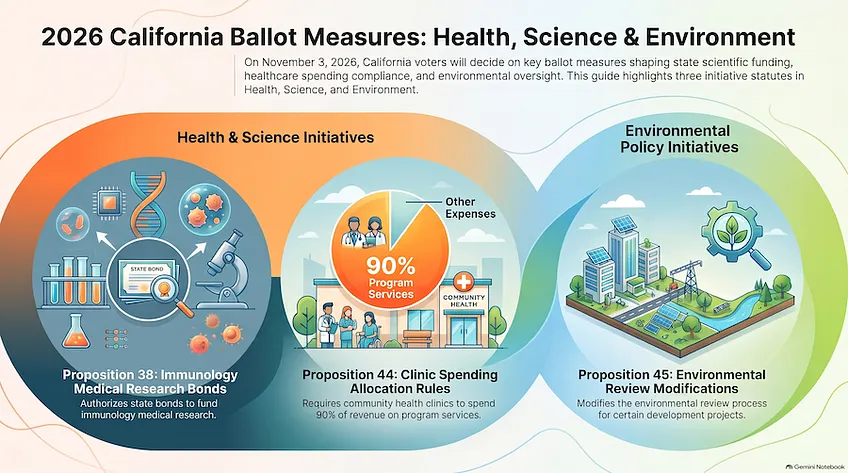
The final collection of this year’s slate of ballot measure focus on health, science and CEQA. Steve Puterski graphic/AI
The final collection of this year’s slate of ballot measure focus on health, science and CEQA. Steve Puterski graphic/AI
Its implementation would require state regulators to determine which clinics are covered, how revenue is calculated, what qualifies as a program service and how compliance is measured.
Supporters argue the proposal would maximize spending on patient care, while opponents contend fixed spending mandates may not reflect operational realities faced by clinics.
Prop. 45 (CEQA Reform)
Finally, this would modify environmental-review requirements for certain housing and infrastructure projects in an effort to accelerate approvals and construction. The measure focuses on California’s environmental-review process, particularly procedures that critics argue increase costs and delay development.
If approved, some qualifying housing and infrastructure projects could move through the approval process more quickly. Supporters argue environmental reviews are frequently used to delay needed projects, especially housing developments. Opponents counter that environmental review remains an important safeguard for communities and natural resources.
The measure does not authorize major borrowing or create a new tax, but it could have significant effects on housing production, infrastructure development and project timelines throughout California.