
In Part III of this special six-part series, North County veteran Tom Robertson continues his Honor Flight San Diego journey with visits to Arlington National Cemetery, the solemn Changing of the Guard at the Tomb of the Unknown Soldier, the Military Women’s Memorial, the U.S. Marine Corps Memorial and the U.S. Navy Memorial.
Part III – The Arlington National Cemetery and the Tomb of the Unknown Soldier, Women in Service Memorial, U.S. Marine Corps Memorial, and the U.S. Navy Memorial
By TR Robertson
Rising early once again and enjoying a hearty breakfast in the Ballroom, the Honor Flight Veterans and Guardians were up and ready to board buses to visit 9 monuments and memorials beginning with the Arlington National Cemetery and the Changing of the Guard at the Tomb of the Unknown Soldier and for the 5 women veterans on the trip a chance to visit the Women in Service Memorial followed by 7 other monuments and memorials located close to and around the National Mall. In honor of the 250th Anniversary of the United States, the next several parts of the story of Honor Flight 2026 will go into a little more detail about each monument or memorial and the importance of the memories these lasting structures represent. The veterans, for the most part, were allowed to tour the monuments and memorials on their own with their guardians. Information was provided on the bus as we drove to each site. A video was also shown on the bus about the World War II Memorial. The veterans would go through a range of emotions throughout the day depending on the memorial we were at and the war years it represented. With the majority of the veterans Vietnam War Vets, the Vietnam Wall Memorial had the most effect on them, especially if they served in country. Many said over and over, we never got a Homecoming like we deserved.
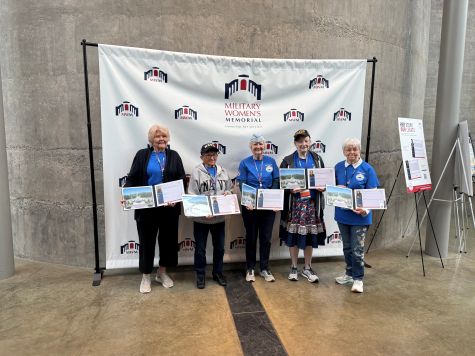
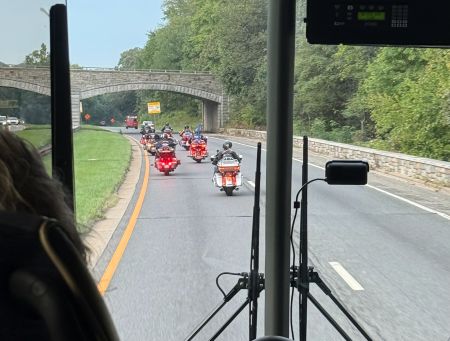
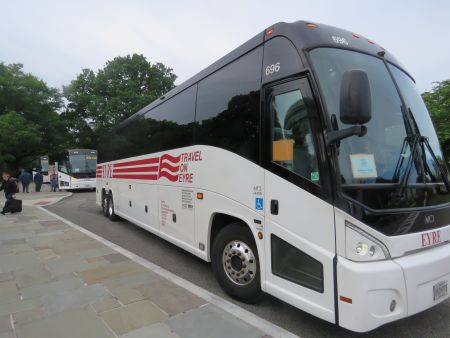
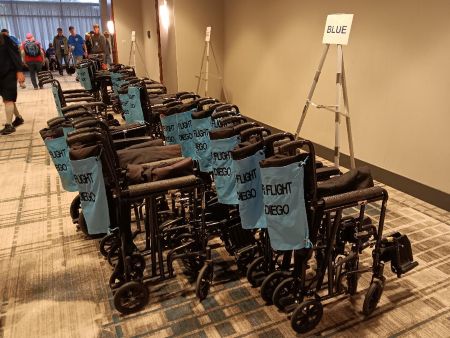
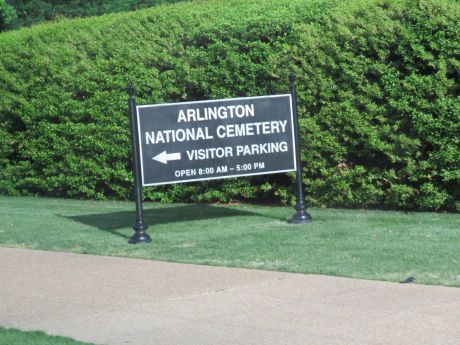
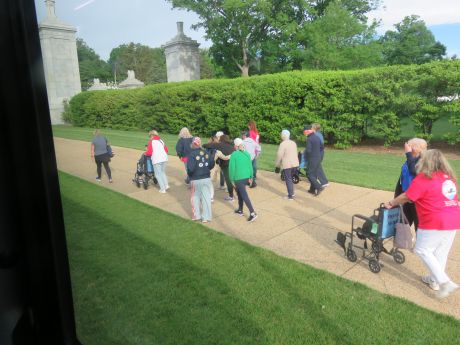
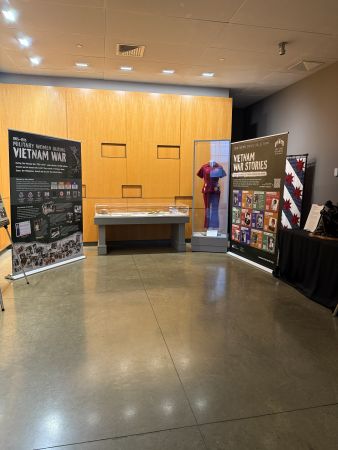
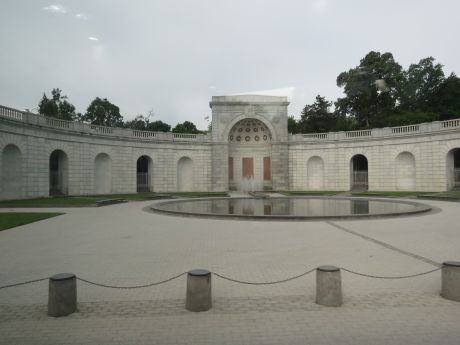
Prior to the Honor Flight trip, all veterans and other personnel on the trip had to fill out and send in an Acknowledgement of Arlington National Cemetery/Women’s Memorial Access/Denial of Access Form and everyone was reminded to have in their possession their Real ID or U.S. Passport to show if asked by authorities at these locations. With everyone on the buses, the Honor Flight Motorcycle group once again led us on the 45-minute ride to the entrance to Arlington National Cemetery. The buses were stopped at the entrance; a guard checked all ID’s and the five female veterans exited to tour the Women in Service in America Memorial and where they received personal recognition certificates.
Women in military service for this nation goes back to the beginning of our country. Today women comprise 17% of our military forces (230,000) and over 3 million have served over the years. Loretta Perfectus Walsh was the first woman to ever enlist (1917-WW I). The Women’s Armed Service Integration Act of 1948 gave women permanent status in the Army, Navy, Marines and Air Force. Anne Dunwoody was the first 4-star general in 2008. All military positions were opened to women in 2015. For our Honor Flight trip, the five female veterans were Donna Jeanne Lavoie, Shirley Ferrill, Mina “Birdie” Ward, Barbara Anderson and Diana Dorsha. Shirley was a nurse in the Korean War and Birdie was in the Air Force, the Army and the Space Force where she helped develop the zero-gravity toilet. The Women in Military Service for America is also known as the Military Women’s Memorial. It is located at the entrance to Arlington National Cemetery, and the location was built in 1932. Originally built as the entrance to Arlington, it was known as the Hemicycle. It never served this purpose and in 1985 Congress approved a site for the Women’s Memorial and in 1988 the former Hemicycle location was selected. Remodeling the interior, the Military Women’s Memorial was opened and dedicated on October 18, 1997, by Air Force Brigadier General Wilma L. Vaught. The memorial is 35,000 square feet of displays, panels, videos, memorabilia and grounds. The women veterans spent the time touring the memorial and each received certificates that had their picture from time in service and information about their specifics for the branch of service they were in and their position within that branch.
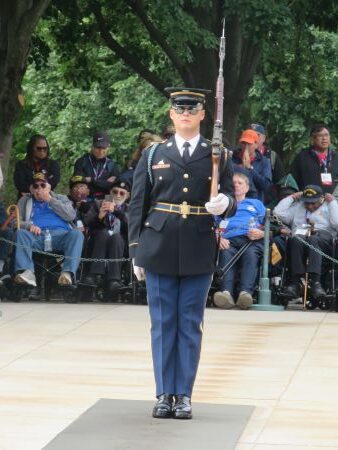
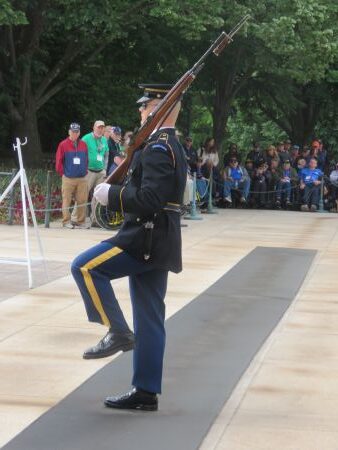
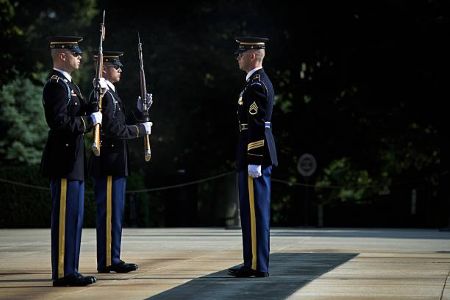
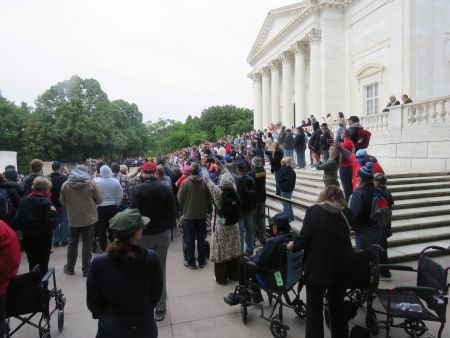
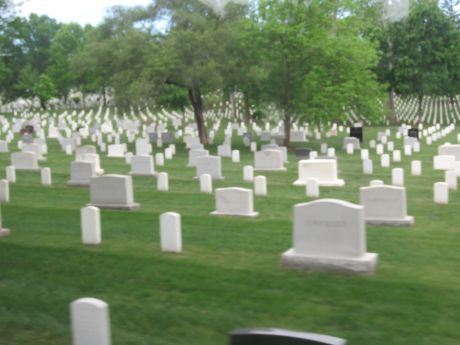
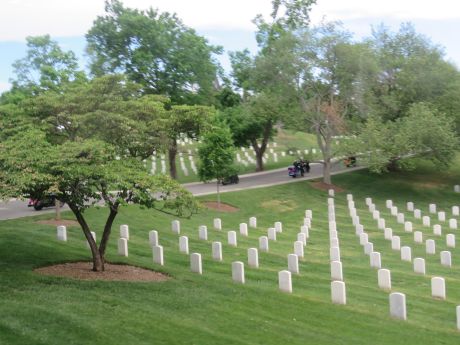
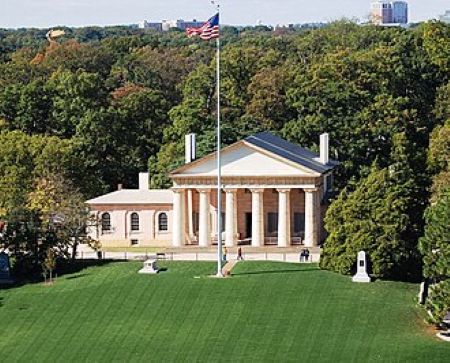
Due to time constraints at Arlington, the male veterans and their guardians continued on into Arlington National Cemetery, driving past thousands and thousands of grave markers. This is the largest cemetery in the U.S. National Cemetery System. There are 440,000+ buried at Arlington on the 639 acres. The Cemetery was established on May 13, 1864, and is divided into 70 sections. There are 16,000 soldiers from the Civil War, including female nurses buried here. There are numerous memorials at Arlington, such as the USS Maine Mast Memorial to the 266 Naval personnel killed, the Space Shuttle Challenger Memorial and the Shuttle Columbia disaster, a Confederate Memorial and a Nurses Memorial to 653 nurses buried at Arlington. Numerous notable burials are in Arlington, such as President William Howard Taft, General John J. Pershing, WW II Pilot Jimmy Doolittle, Astronauts Gus Grissom – Roger Chaffee – John Glen and the most decorated soldier in history – Audie Murphy. The most famous and most visited burial site is President John F. Kennedy (featuring the eternal flame), wife Jacquline Kennedy and Senator Robert F. Kennedy.
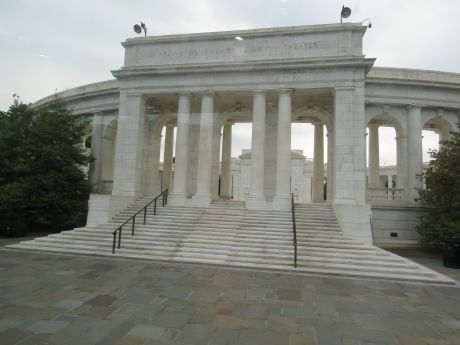
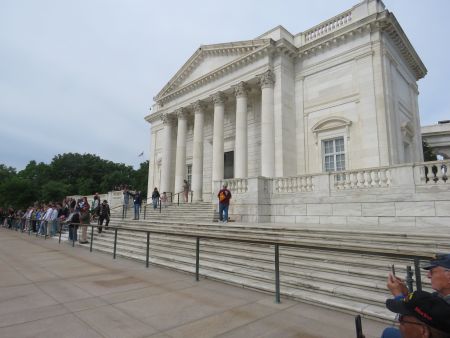
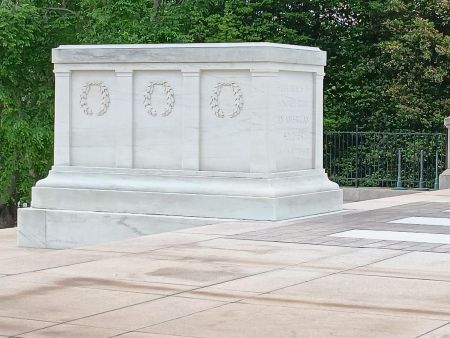
The buses dropped the veterans off at the front of the Memorial Amphitheater, built in 1920. The Tomb of the Unknown Soldier is a short walk around the outside of the Amphitheater to the eastern plaza. The Tomb of the Unknown Soldier and the Changing of the Guard is a solemn ceremony that also attracts thousands of visitors. An unknown soldier from WW I was interred in the Tomb on November 11, 1921, and the ceremony presided over by President Warren G. Harding. The Tomb of the Unknown Soldier has been perpetually guarded since July 2, 1937. It is guarded 24/7 by the U.S. Army 3rd U.S. Infantry Regiment (The Old Guard) since April 1948. There is a symbolic formality to the Sentinel’s “walking the mat” march. The guard marches 21 steps southward down a black mat located behind the tomb. The guard then turns left, facing east for 21 seconds. Then the guard turns left, facing north for 21 seconds. The Sentinel takes 21 steps down the 63-foot mat, then repeats the routine until the soldier is relieved of duty by the “Changing of the Guard”. After each turn the Sentinel executes a sharp “Shoulder-arms” movement to place the weapon on the shoulder closest to the visitors to signify that the Sentinel stands between the Tomb and any possible threat. The guards are referred to as Sentinels. Twenty-one was chosen because it symbolizes the highest military honor that can be bestowed – the 21-gun salute. The numbers 1776, the founding of the Republic, add up to 21. The guard is changed every half hour during daylight summer and every hour daylight winter; every two hours at night when the cemetery is closed to the public regardless of weather conditions. The “Changing of the Guard” is also what is referred to as a “meticulously precise ceremony” with the Sentinel on duty, the Sentinel coming on duty and the Relief Commander. This ceremony lasts 12-15 minutes. The hundreds of visitors on the day we were there solemnly watched both the Sentinel guarding the Tomb and the Changing of the Guard.
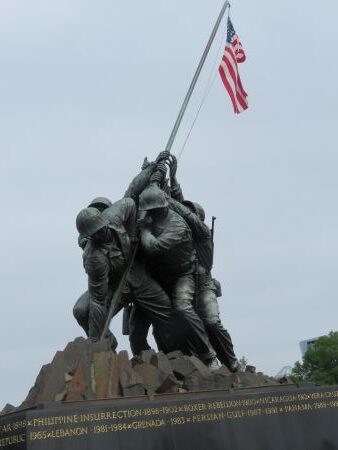
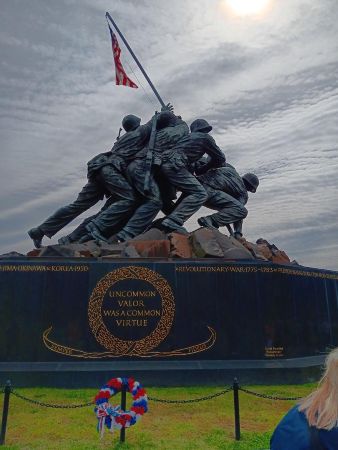
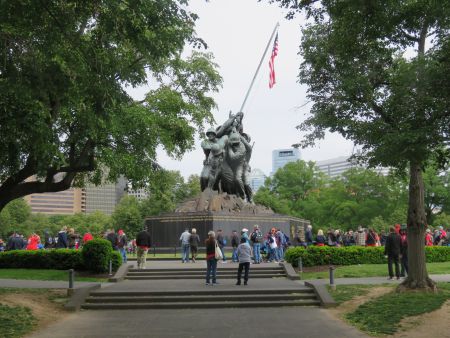
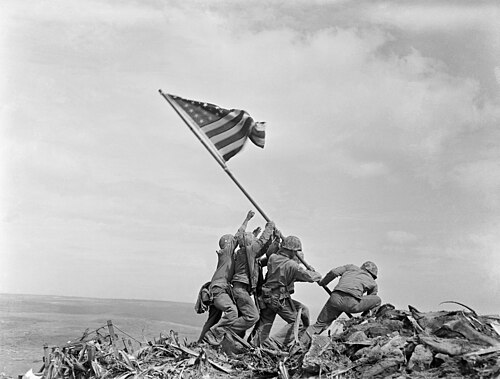
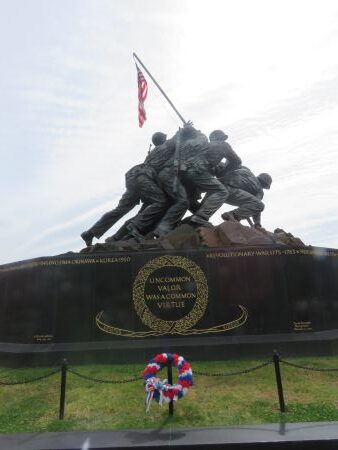
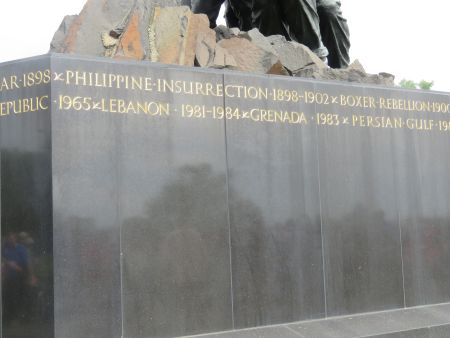
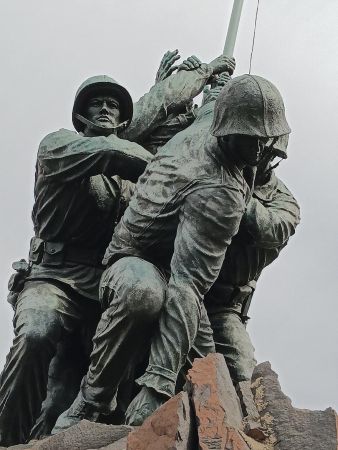
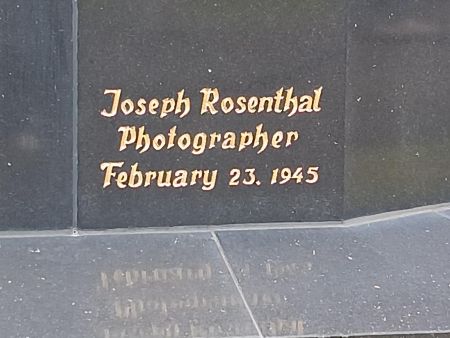
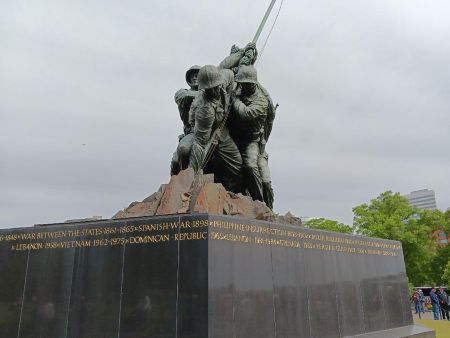
Leaving this area, we boarded our buses, picked up the women vets at the entrance and were back on the road to the U.S. Marine War Memorial in Arlington Ridge Park, Arlington, Virginia. A short drive brought us to this memorial that honors all Marines who have died in defense of the U.S. since 1775. The memorial was inspired by the 1945 photograph of Marines raising a U.S. flag atop Mt. Suribachi, Iwo Jima, on February 23, 1945. The photo was shot by combat photographer Joe Rosenthal. In the photo, 6 Marines are raising the second, and largest of the flags raised atop Mount Suribachi. The flag raising was also filmed by Marine Sergeant Bill Genaust. The names of the 6 Marines are: Corporal Harlon H. Block, Corporal Harold P. Keller, Private 1st class Franklin R. Sousley, Sergeant Michael Strank, Private First-Class Harold H. Schultz and Private First-Class Ira H. Hayes. Architect Horace Peaslee designed the memorial and sculptor Felix de Weldon created the memorial. The entire memorial is 78 feet tall; the figures are 32 feet tall, and the bronze flagpole is 60 feet long. The granite base came from Sweden. It cost $850,000 to build the memorial and no public funds were used. Money was donated by the U.S. Marine Corps, Friends of the Marine Corps and Members of the Naval Service. President Dwight Eisenhower dedicated the memorial on November 10, 1954, the 179th anniversary of the U.S. Marine Corps. There are several engravings on the base, such as “Uncommon Valor Was a Common Virtue – Semper Fidelis” and the majority of the wars and engagements the Marine Corps has been involved in.
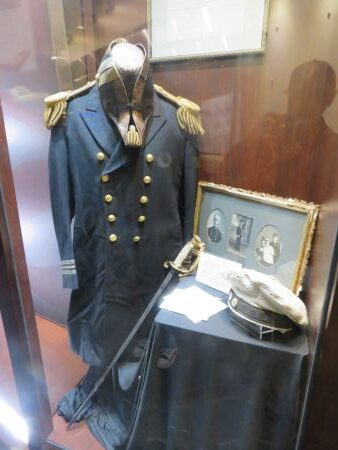
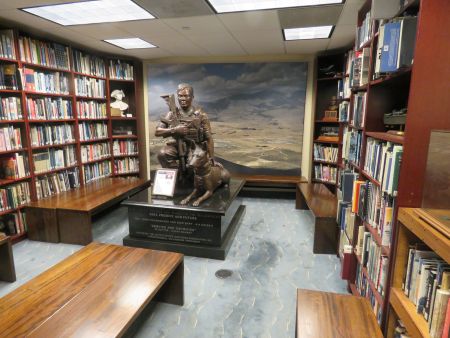
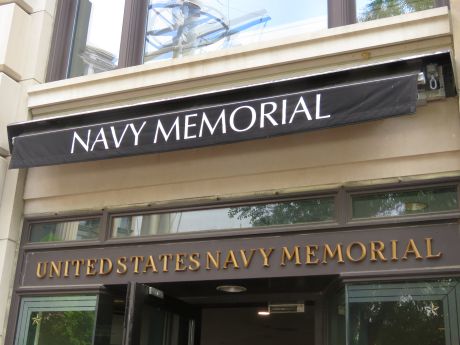
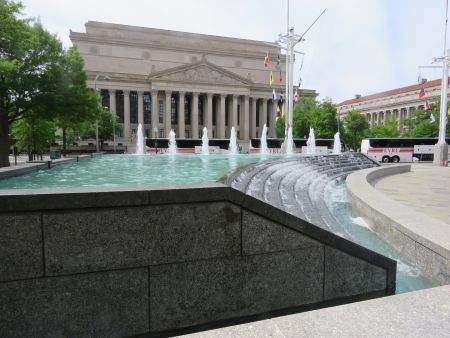
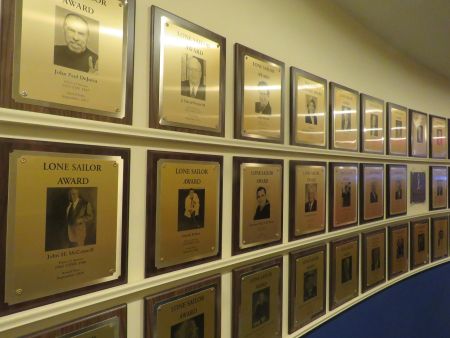
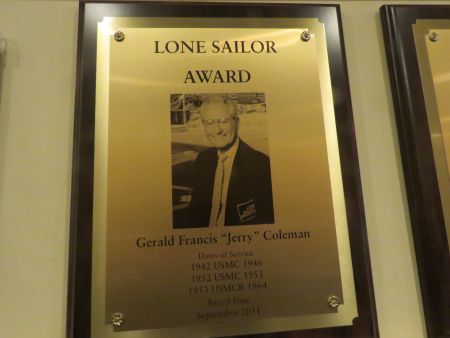
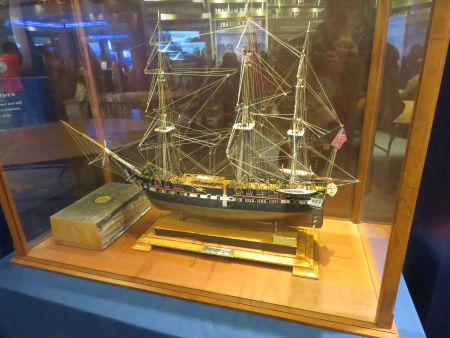
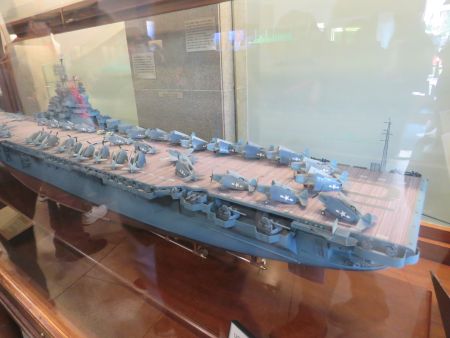
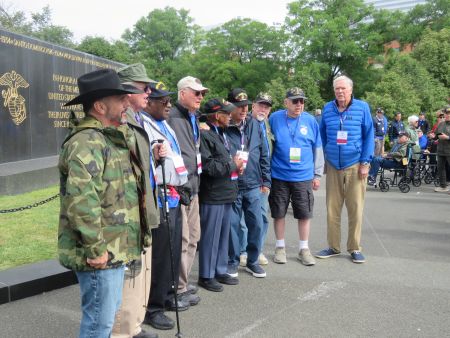
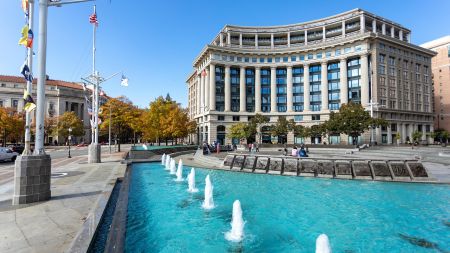
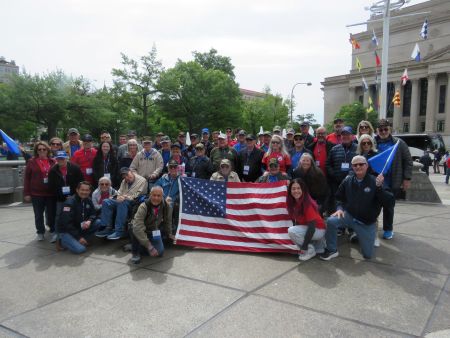
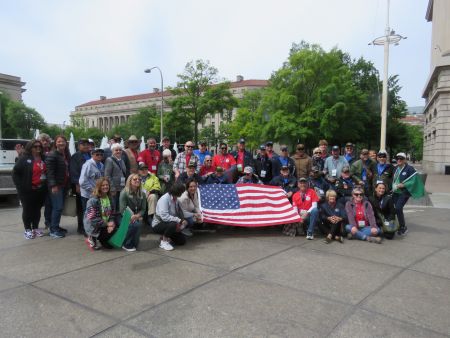
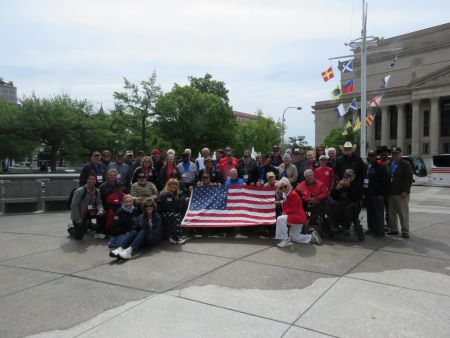
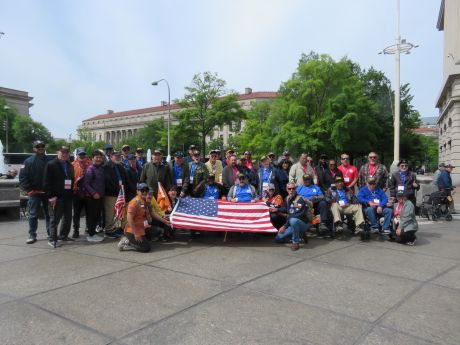
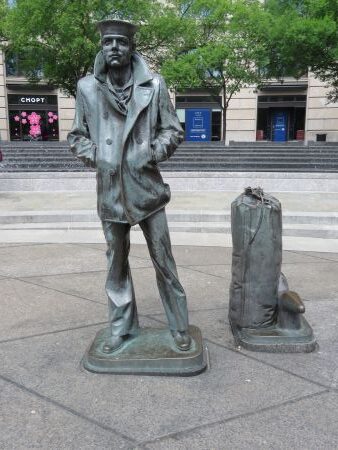
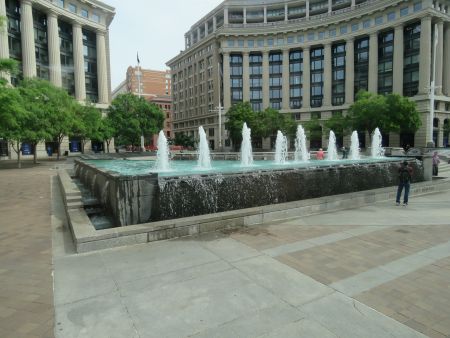
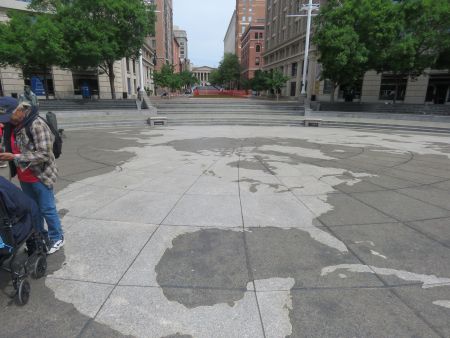
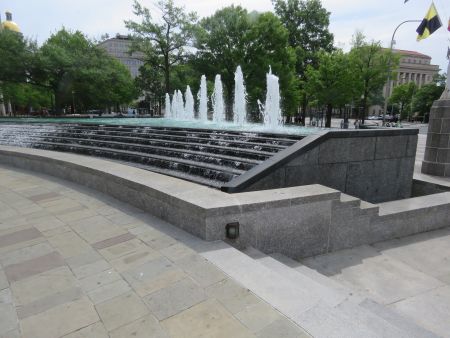
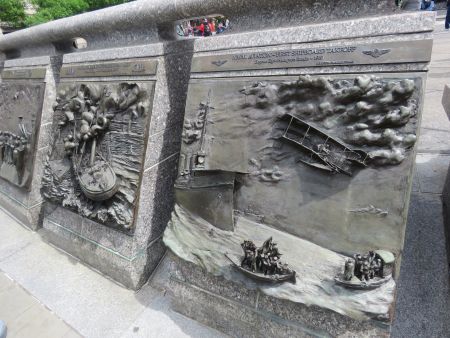
The next memorial was a short drive away, located on Pennsylvania Avenue between 7th Street Northwest and 9th Street Northwest, the U.S. Naval Memorial. The U.S. Naval Memorial honors those serving, past and present, in Navy, Marine Corps, Coast Guard and Merchant Marine. The memorial consists of two parts, an outdoor area with water features, plaques, a statue and a large 100 ft. in diameter granite world map and a second part a Visitors Center and small museum. The outdoor section features water features surrounded by outdoor walls that have famous sayings and bronze relief plaques showing the history of the U.S. Navy, Marines, Coast Guard and Merchant Marines. There is also a statue, completed by Stanley Bleifeld, called the Lone Sailor Statue. This 7 ft, bronze statue depicts personnel of all sea services. Next to the outdoor plaza area is a Visitor Center entrance that has an elevator and stairs that lead down to a one level museum featuring exhibits, ship models, commemorative plaques, uniforms, badges and insignias and a small gift shop. The U.S, Naval Memorial was dedicated om October 13, 1987, the 212th birthday of the U.S. Navy. While at the outdoor area we took time to shoot Team photos of Blue, Red, Green and Orange Honor Flight San Diego Groups. Each vet wore not only their Honor Flight T-shirts, but most wore their Team color bracelets, specially made by the Coronado High School NJROTC Islander Company Cadets.
Part IV will focus on the Franklin Delano Roosevelt Memorial, the Dr. Martin Luther King Jr. Memorial and the World War II Memorial.