
As America prepares to mark its 250th anniversary, North County Daily Star continues this special six-part series honoring veterans, sharing their stories and highlighting the mission of Honor Flight San Diego.
In Part 4, North County veteran Tom Robertson continues the Honor Flight San Diego journey through Washington, D.C., with visits to the Franklin Delano Roosevelt Memorial, the Martin Luther King, Jr. Memorial and the World War II Memorial.
Honor Flight San Diego Once Again Provides Memories for Veterans
Part 4 – The Franklin Delano Roosevelt Memorial, Dr. Martin Luther King, Jr. Memorial, and the World War II Memorial
By TR Robertson
Back on the buses after a visit to the U.S. Naval Memorial, another short drive took us to two memorial parks located along the Tidal Basin. These two memorial parks are a 7.5-acre outdoor park dedicated to the 32nd President of the United States, Franklin Delano Roosevelt, and a 4-acre park dedicated to the Civil Rights Movement leader Martin Luther King, Jr. Both Memorial Parks are located in West Potomac Park along Cherry Tree Walk. It was here we had a lunch break with wraps from Arby’s we could enjoy in the relaxed atmosphere of the park.
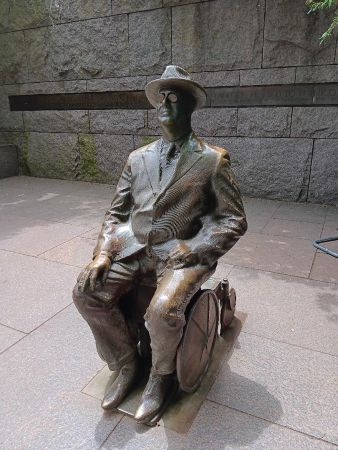
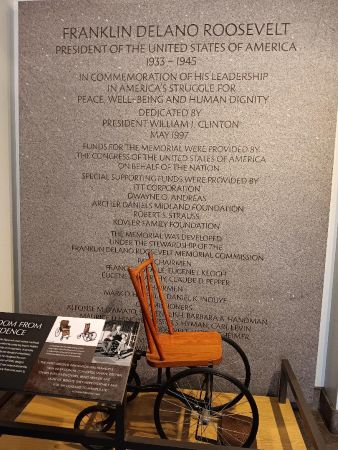
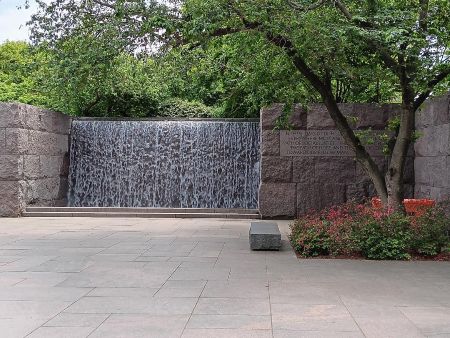
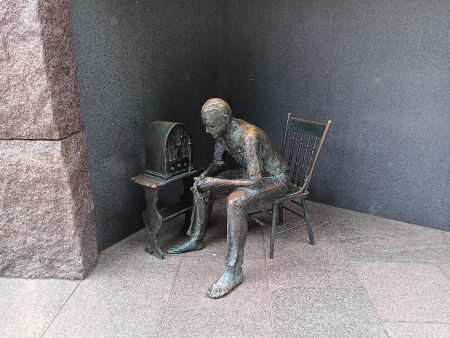
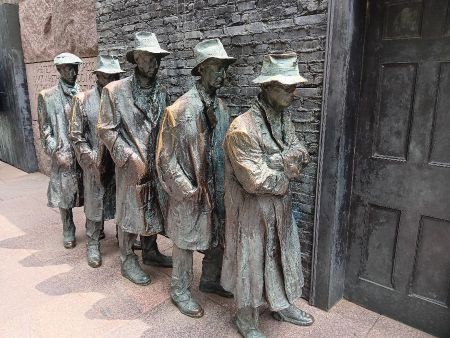
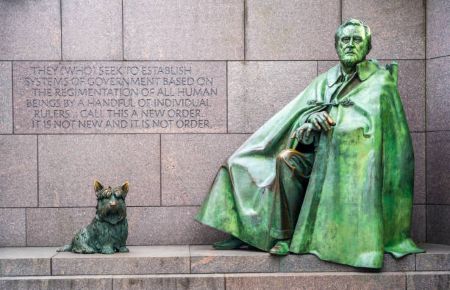
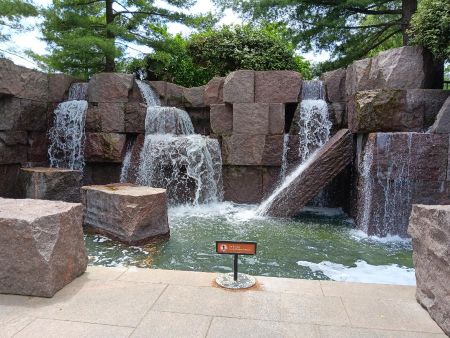
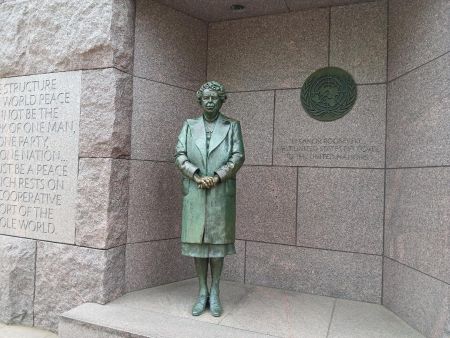
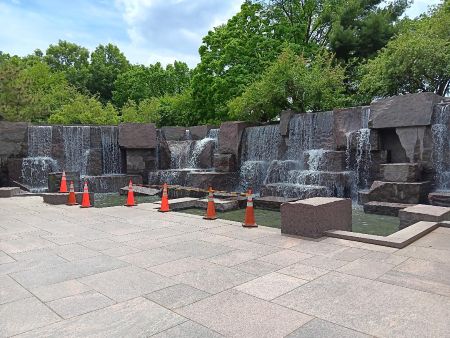
The Franklin Delano Roosevelt Memorial features granite walls and designs, waterfalls, bronze sculptures and 27 engraved quotations from FDR. The Memorial covers FDR’s 12 years as President featuring the Great Depression, World War II, and wife Eleanor. Visitors wander through the Memorial walking through 4 outdoor rooms that cover the time period 1933-1945. The Memorial was designed by landscape artist Lawrence Halprin. There are a number of bronze sculptures in the Memorial created by different sculptors. Neil Estern created FDR and his dog Fala and the Eleanor Roosevelt Statue, Robert Graham created FDR in his wheelchair, George Segal created The Breadline and the Fireside Chat, Leonard Baskin created the reliefs representing FDR’s funeral and Tom Hardy created other bas-reliefs. Some of these tactile reliefs have braille writing for the blind. A volunteer guide at the Memorial explained that the different waterfalls have symbolic meanings. The large single drop waterfall is said to represent the Great Depression and crash of the economy; the multiple stair-step drops represent the Tennessee Valley Authority dam building projects; the chaotic falls at various angles represent WW II; the still pool represents Roosevelt’s death; and the large array of all of the different waterfalls represent Roosevelt’s presidency. The large bronze statue of FDR in his wheelchair signifies the President slightly hiding his disability with only a back corner of the wheelchair casters visible. Eleanor Roosevelt’s statue is the first statue to honor a First Lady included at a Presidential Memorial. The FDR Memorial was dedicated in 1997 by President Bill Clinton. There is also a small gift shop in the park.
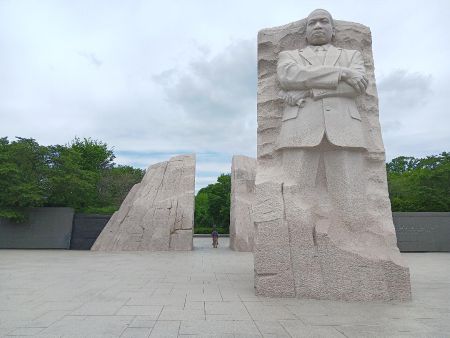
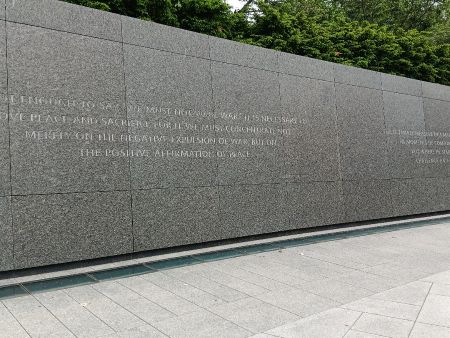
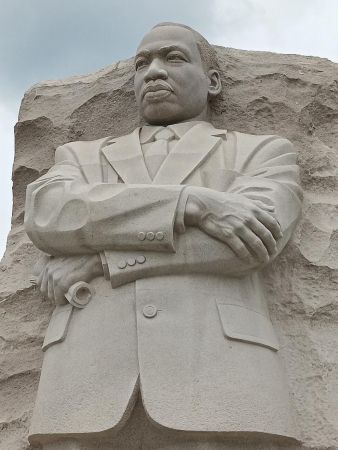
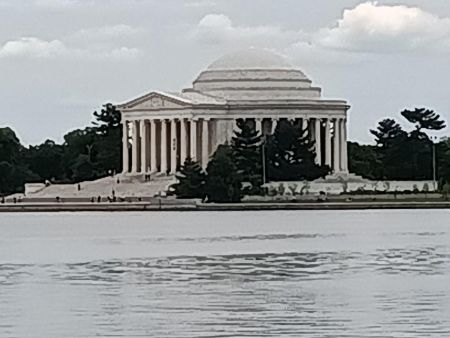
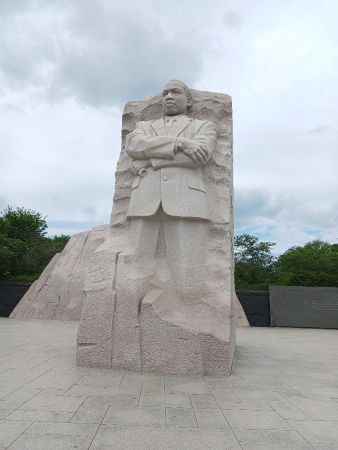
A short walk along the Tidal Basin brings you to the second memorial park in West Potomac Park, the Martin Luther King, Jr. Memorial. This 4-acre park, open to the public on August 22, 2011, has as its center piece a 30-foot tall “Stone of Hope” granite statue of Dr. King, carved by Lei Yixin. The sculpture was inspired by a line from one of Dr. King’s speeches, “Out of the mountain of despair, a stone of hope”. The Memorial Park also features a split granite entrance which is called the “Mountain of Despair” and a 450-foot-long inscription wall, in two sections, engraved with quotes from Dr. King’s speeches, such as the “I Have a Dream” speech. The Memorial Park is a result of the efforts of Alpha Phi Alpha fraternity, which King was a member of while attending Boston University. Financial contributors included General Motors, Bill and Melinda Gates, George Lucas, Steven Spielberg, Walt Disney Foundation, the NBA and many others. The “Stone of Hope” statue looks across the Tidal Basin toward the Thomas Jefferson Memorial. The memorial was dedicated on October 16, 2011, by President Barrack Obama. It had been postponed due to Hurricane Irene.
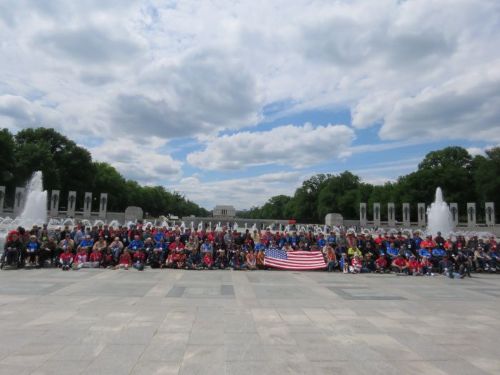
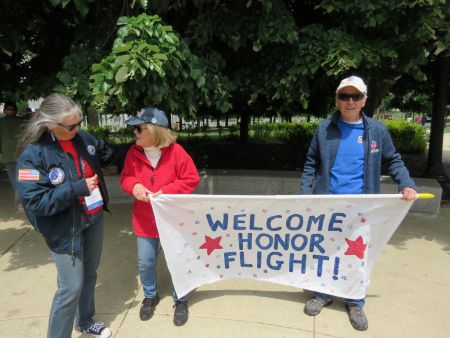
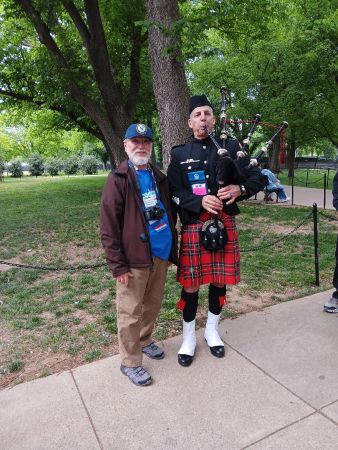
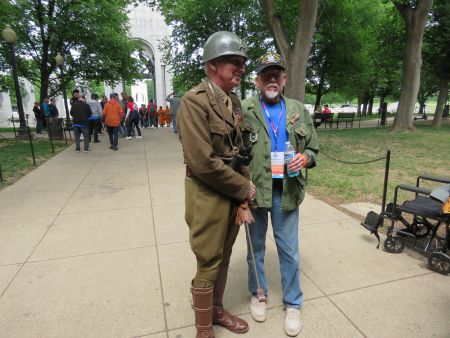
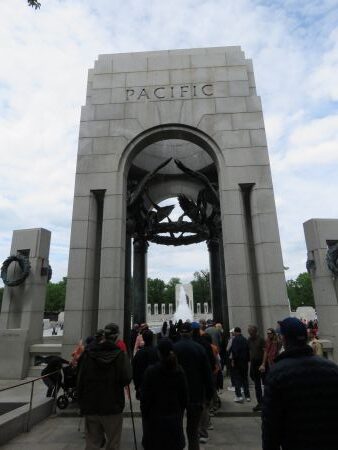
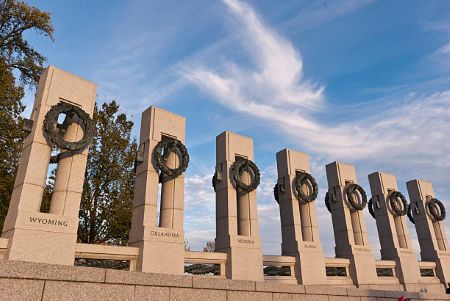
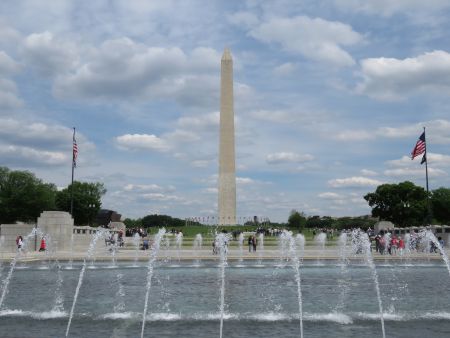
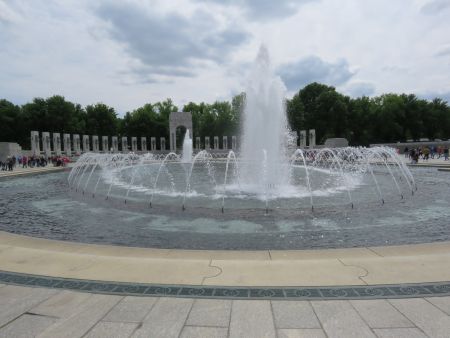
Back on the buses our group next headed to a spot close to the National Mall where the World War II Memorial is located, between the Lincoln Memorial and the Washington Monument. Welcoming us as we entered the WW II Memorial were signs welcoming Honor Flight veterans, a Scottish bagpiper, a George Patton impersonator and a wonderfully dressed lady in a 1940’s outfit. This large memorial honors the 16 million Americans who served in WW II and the 407,300 American military deaths. The WW II Memorial was dedicated in 2004 by President George W. Bush. The Memorial features 56 large pillars for the states and territories that existed in 1945; two triumphal arches representing the Atlantic and Pacific War theaters and a large oval plaza with a central fountain. Close to the oval plaza fountain is a Freedom Wall with 4,048 gold stars each representing 100 American deaths. The large pillars stand 17 feet high. Forty-eight of them represent the states in the U.S. in 1945. The rest of the pillars represent the Territory of Alaska and Hawaii, the Commonwealth of the Philippines, Puerto Rico, Guam, American Sumor and the U.S. Virgin Islands. The two arches engraved with Atlantic and Pacific are 43 feet tall and inside each arch are four large bronze eagles with 11-foot wing spans. The plaza is 337 feet long and 240 feet wide. The pool is 246 feet long and 142 feet wide. There are also 2 walls of bas-relief scenes of war experiences. There were 400 designs submitted for consideration for the memorial and the designed submitted by Friedrich St. Florian was selected in 1997. There was some initial controversy about the design being too grandiose and the location disrupting the view of the Washington Monument and Lincoln Memorial.
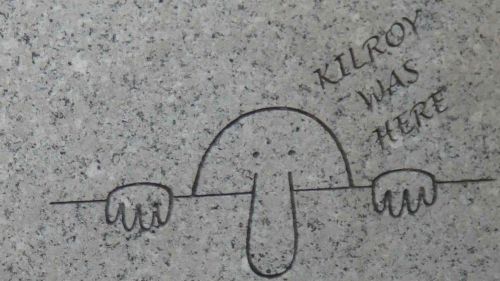
One interesting addition to the WW II Memorial was two “Kilroy was here” engravings. We were told to try and locate the engravings. I’ll include a photo but won’t tell you where they are located in case you ever visit the memorial; you can look for it yourself. This American graffiti slogan was popularized by GIs in World War II. The saying originated from James J. Kilroy, a shipyard inspector in Quincy, Massachusetts in the 1930’s & 40’s, who used the phrase to mark inspected rivets. These soon appeared on ships and spread globally and to some Americans symbolizing a mark of American presence. The character has a long nose and is peeking over a wall. Some say it originated from a British character known as “Chad” or “The Watcher”. Soldiers in both the Atlantic and Pacific theaters of war would draw or carve the slogan on anything that was handy.
Come back for Part 5, which will cover the three memorials located very close to one another at the western end of the National Mall – the Korean War Memorial, Vietnam Veterans Memorial and the Lincoln Memorial.