

By Edward Ring
July 23, 2026 6:30 AM
2026 National Review
The federal government has options for dealing with political resistance in California.
The operating agreements that govern Colorado River allocations expire at the end of this year, and negotiations between the seven states that share the water are stalled. With the federal government poised to step in and impose an agreement it formulates, the states — Colorado, New Mexico, Utah, and Wyoming in the upper basin, and Arizona, California, and Nevada in the lower basin — have asked for more time.
Whether or not the ongoing drought on the Colorado watershed will pass, or is a permanent feature of climate change, the problem is real and acute. During the 20th century, the Colorado River delivered to its lower basin states an average flow of 14.6 million acre feet per year. At the dawn of the 21st century, Lake Powell and Lake Mead, two of the largest reservoirs in the world, were close to full, together storing over 50 million acre feet.
Since then, the average annual flow to the lower basin states has fallen to 12.4 million acre feet. Lake Powell is now only 23 percent full, and Lake Mead is only 27 percent full. While new conservation measures can reduce this deficit, finding a major new source of fresh water will make the transition much easier. For this reason, the federal government should consider large-scale seawater desalination on the California coast, where San Diego, Orange, and Los Angeles Counties, along with adjacent inland counties, consume up to 1 million acre feet of water from the Colorado River every year.
California’s DEI Bloat Clashes with Newsom’s Pivot to ‘Normal’
Opponents of desalination claim that it’s costly, wastes energy, and exerts a negative environmental impact. But these objections don’t hold up to modern realities. When put in the proper perspective, the energy cost for desalination is reasonable. State-of-the-art seawater desalination plants would require 3,500 gigawatt-hours to produce 1 million acre feet of fresh water. In California, that is roughly the same amount of electricity that is required to pump 1 million acre feet of water over a distance of 400 miles from the Sacramento–San Joaquin Delta through the California Aqueduct, over the Tehachapi Mountains, and into the Los Angeles Basin. Put another way, 3,500 GWh is equal to barely more than 1 percent of California’s current electricity consumption.

The environmental impact of desalination rests on two concerns: the saltwater intakes and the discharges of brine. But modern desalination plants can be designed with multiple intakes, each with a very large surface area, in order to minimize the velocity of the seawater against their outer filters. The use of these intakes can be rotated so that the pressure in each of them can be periodically reversed in order to expel any biota that accumulates against them. As for the brine, which is merely water with twice the salt content as the ocean, it can be disbursed under pressure into the California current, where it is immediately and harmlessly dissipated.
As for the cost of building desalination plants, construction financing costs are around $1,000 per acre foot. This is a price that municipal water districts in Arizona or Nevada might gladly help cover, taking pressure off ratepayers in Southern California. Exchanging rights to Colorado River water for assistance with desalination-plant financing is a mutually beneficial partnership. The operating cost for energy to desalinate, even at California’s ridiculously high retail price of $.30 per kilowatt-hour, is also only around $1,000 per acre foot. Compare this with the wholesale cost of treated, potable water from the Metropolitan Water District of Southern California, already $1,500 per acre foot and projected to nearly double within the next ten years.
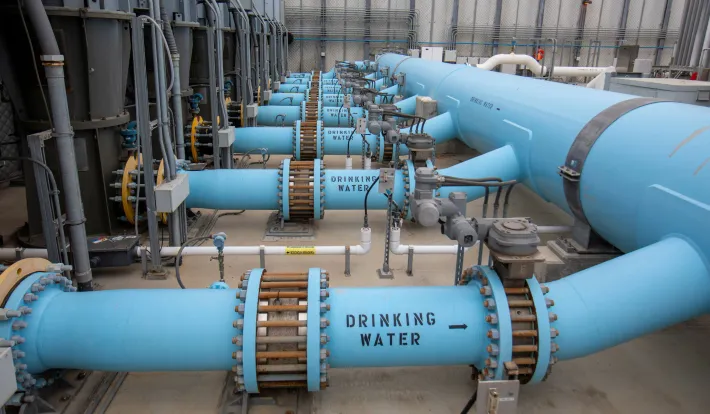
Pipes containing drinking water at the Poseidon Water desalination plant in Carlsbad, Calif., in 2021 (Mike Blake/Reuters)
What generally stops conversations about large-scale desalination in California before they have a chance to get going is the implacable political resistance to this solution, led by the powerful California Coastal Commission but echoed across most of the state’s regulatory agencies. Nevertheless, the federal government has options. The Submerged Lands Act and the Coastal Zone Management Act, while awarding significant control over coastlines to the states, contain provisions for the federal government to override states in matters of national security and interstate commerce. Both of these factors apply today. Multiple states are involved in resolving the challenge of a shrinking supply of fresh water from the Colorado River. And California’s coastal cities are dangerously dependent on imported water through aqueducts and pump stations that could be disabled at any time by natural catastrophes or terrorism.
There are existing federally owned sites along the California coast situated in close proximity to the state’s great coastal metropolises. There are also several natural gas power plants sited along the California coast set to be decommissioned, if they haven’t been already. They offer preexisting locations, intakes, and transmission lines. New desalination plants could be co-located with small modular reactors, so they could export clean surplus electricity along with fresh water.
Large-scale seawater desalination plants on the Southern California coast could make a major contribution to resolving the deficit between supply and demand from the Colorado River. The energy, environmental, and financing concerns are manageable. And the federal government has existing authority to compel the State of California to embark on this major infrastructure initiative for the benefit of the entire American Southwest.